I'm going to be honest with you.
I've been covering Google I/O for over a decade. I've seen the Google Glass debacle. I've watched Google+ rise and fall. I've sat through endless "self-driving cars are coming" keynotes.
But yesterday? Yesterday was different.
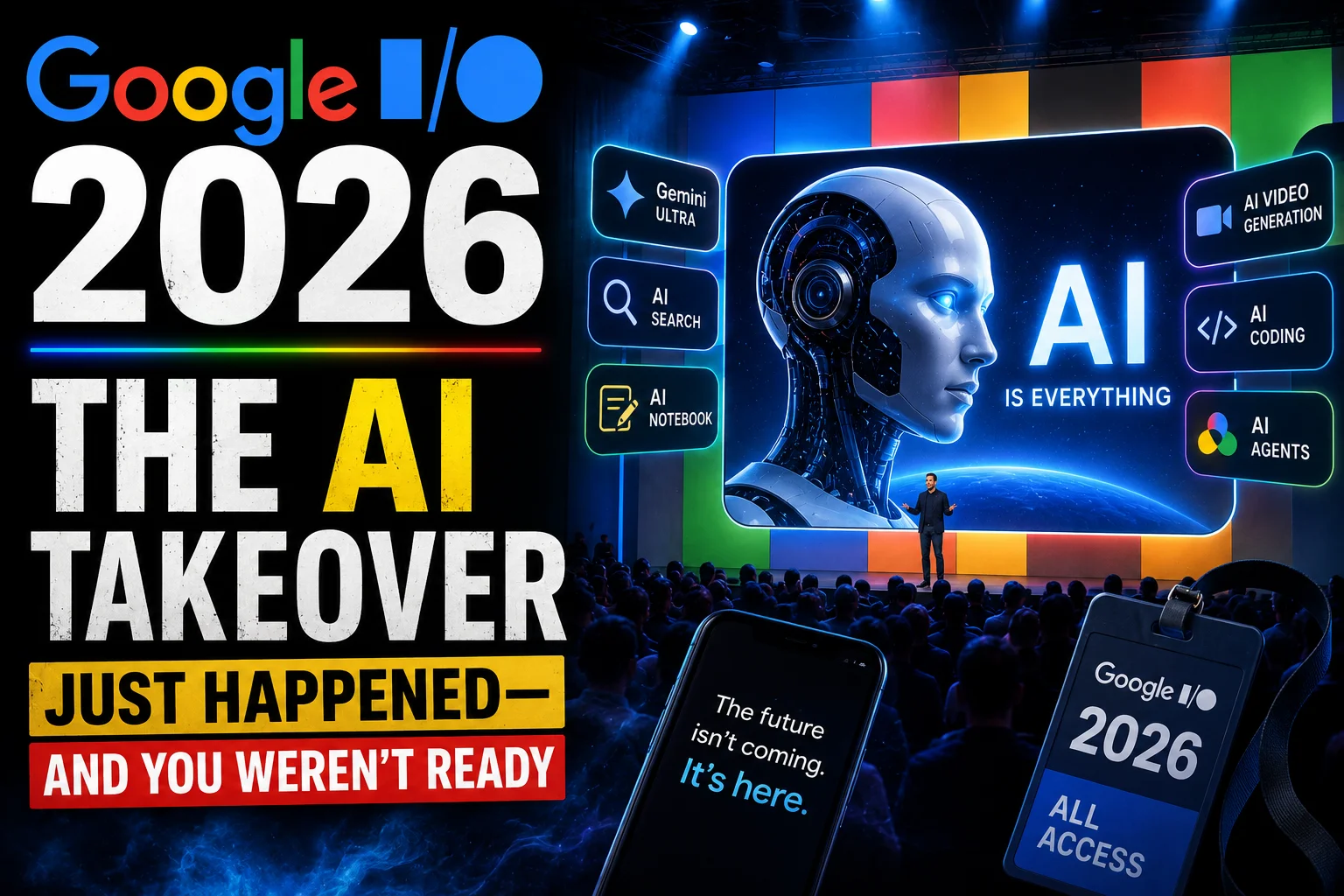
Google just dropped a bomb on the tech world, and most people haven't even realized how big it is. The headlines are calling it "Google I/O 2026," but that's like calling World War II "a minor disagreement in Europe." This was an AI takeover—and it's going to change everything about how you search, how you work, and how you live online.
Let me break down what happened, why it matters, and what you need to do about it. Because if you're a content creator, a marketer, a business owner, or literally anyone who uses Google (so, everyone), your world just shifted.
The Big Picture: Google Just Declared War on Traditional Search
Here's the headline that should scare every SEO professional in the room:
Google Search no longer shows you links.
Okay, that's not entirely true—yet. But it's moving there faster than anyone predicted.
At I/O 2026, Google announced what they're calling the biggest upgrade to the search box in over twenty-five years . And they're not exaggerating.
The new search experience does three things that break the old model:
One: You can now input text, images, files, videos, and Chrome tabs simultaneously—and Google reasons across all of them at once . Want to find that restaurant your friend mentioned in an email, with the photo you took last summer, and the YouTube video someone sent you? One search. Done.
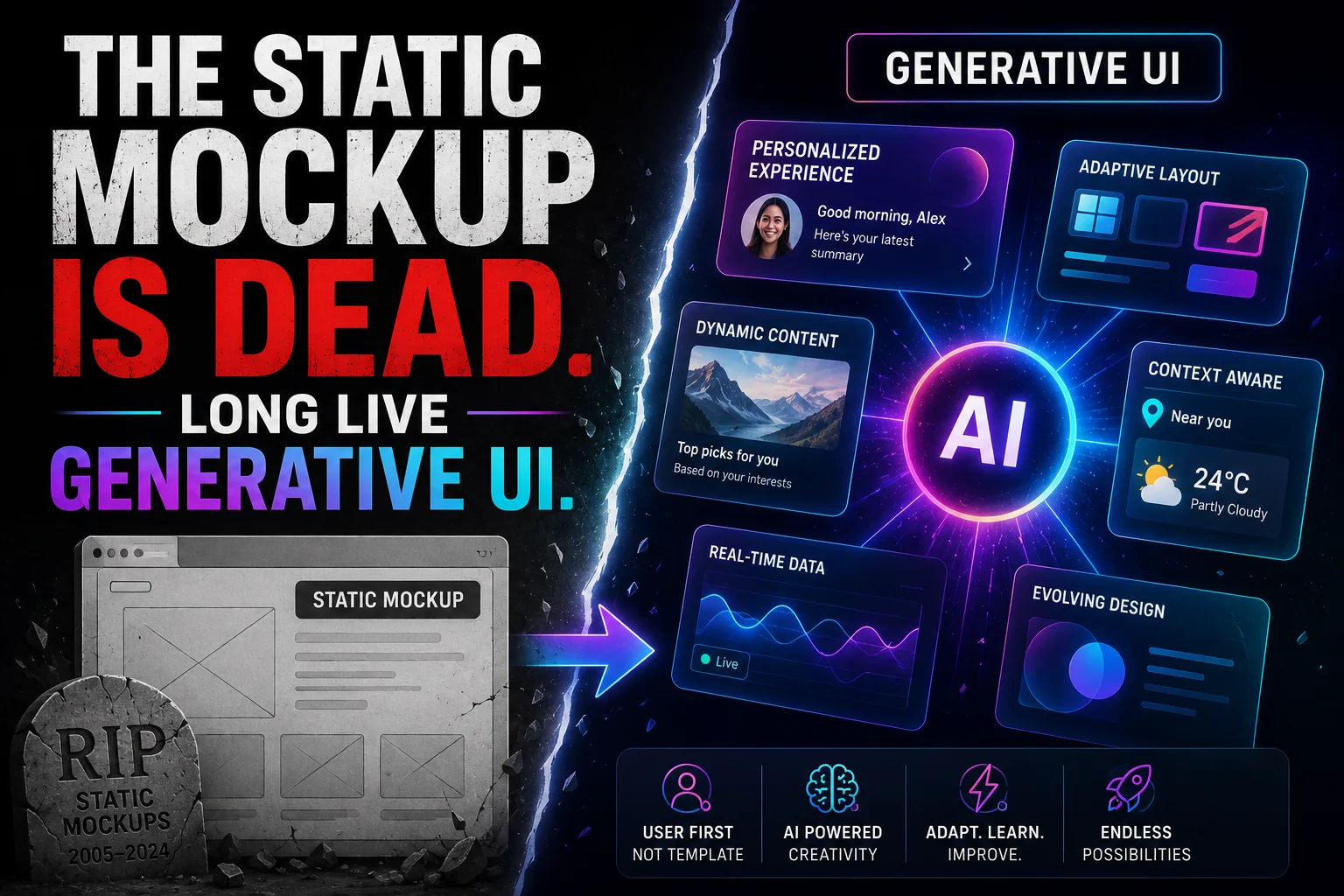
Two: Instead of giving you a list of blue links, Search now builds a generative UI on the fly . Search "weekend activities in Chicago" and Google doesn't just list events—it creates an interactive, customizable itinerary tool right there in the search results. A mini-app. Generated instantly. For you.
Three: Search now has AI Mode with something called "Personal Intelligence." This is where things get wild. If you opt in (and pay for the privilege, more on that in a minute), AI Mode can read your Gmail and scan your Google Photos to personalize your results .
Let me give you the example Google showed: Search for "trip activities" and AI Mode pulls your hotel booking confirmation from Gmail, finds photos from your past vacations, and builds an itinerary based on your actual travel history .
Not generic recommendations. Not "people also liked." Your. Actual. Context.
This is the death of traditional search as we've known it since 1998. We're not typing keywords into a box anymore. We're having conversations with an AI that knows us better than we know ourselves.
Gemini 3.1 Ultra: The Brain Behind the Takeover
All of this is powered by Google's new flagship model: Gemini 3.1 Ultra.
Actually, that's not even the latest. Google also dropped Gemini 3.5 Flash during the keynote—a model specifically designed for "agentic tasks," meaning AI that doesn't just answer questions but actually does things .
Here's the stat that made my jaw drop: Gemini 3.5 Flash outputs text four times faster than competing frontier models, at less than half the price . That's not incremental improvement. That's a leap.
But the real monster is still Gemini 3.1 Ultra, which features a massive 2-million-token context window. Let me put that number in perspective for you.
You can drop entire codebases into this thing. You can feed it hundreds of research papers. You can upload your company's entire Slack history from the past year. And Gemini will remember all of it, reason across all of it, and answer questions about any of it.
Google is also rolling out something called TurboQuant, a new technology that supposedly solves major AI memory bottlenecks. Translation: They've figured out how to make these massive models run without crashing or costing a fortune. The technical details are sparse, but the implication is clear—Google is removing the last barriers between AI and total integration into everything.
AI Mode: The End of "Googling"
Let me spend a minute on AI Mode because this is the feature that will affect the most people.
When you search in AI Mode, you don't get a results page. You get a conversation. Google's AI generates a comprehensive, human-like response that answers your question directly—with links to sources, yes, but the links are secondary. The answer is primary .
Here's what that means for you: You no longer need to click through to websites to get information. The information comes to you.
Google says AI Mode already has over 10 billion monthly active users . That's not a typo. Ten. Billion. People are already using this, and it's about to roll out to everyone.
But the real game-changer is Personal Intelligence, which I mentioned earlier. With your permission, AI Mode can now:
-
Reference hotel and flight confirmations from your Gmail to suggest travel plans
-
Scan your Google Photos to understand your preferences (if you take a lot of ice cream selfies, it'll recommend ice cream shops)
-
Prioritize products from brands you've actually bought before when you shop online
-
Remember your dietary restrictions, your clothing size, your kids' ages—everything you'd normally have to type out fresh each time
Google VP Robby Stein put it this way: "With Personal Intelligence, recommendations don't just match your interests—they fit seamlessly into your life. You don't have to constantly explain your preferences or existing plans" .
The privacy implications are enormous, and Google is trying to get ahead of them. The feature is opt-in only, and Google says it doesn't train directly on your Gmail or Photos data . But let's be real—you're giving Google access to your entire digital life in exchange for convenience. Whether that trade is worth it is a question only you can answer.
Gemini Spark: The Agent That Works While You Sleep
Okay, this is the announcement that genuinely freaked me out.
Google introduced something called Gemini Spark, and it's not a chatbot. It's not a search tool. It's a 24/7 personal AI agent that runs on Google Cloud—not on your device .
Here's what that means: You can close your laptop. Go to sleep. Go on vacation. And Spark keeps working.
In the background. On Google's servers. Doing tasks for you.
What kind of tasks? The demo showed Spark planning a neighborhood block party . It:
-
Summarized all email RSVPs automatically
-
Tracked what everyone said they'd bring
-
Followed up with people who hadn't responded
-
Built a real-time tracker in Google Sheets
-
Created a promotional slide deck in Google Slides
All without the user lifting a finger after the initial request.
Spark can also give you a Daily Brief—a personalized morning summary that pulls updates from your Gmail, Calendar, and Gemini chats to show you priorities and suggested next steps .
This is the shift from "AI as assistant" to "AI as employee." And it's happening right now.
Spark is initially rolling out to Google AI Ultra subscribers in the US (that's the $100-200/month tier), with a beta starting next week . Free users will get access "when the time is right," which is Google's polite way of saying "probably never" .
What This Means for SEO: Welcome to GEO
If you work in search engine optimization, I have bad news and interesting news.
The bad news: Traditional SEO is dying. Google is moving from "10 blue links" to "one AI-generated answer." If your entire strategy was ranking for keywords and getting clicks, you're in trouble.
The interesting news: There's a new discipline called Generative Engine Optimization (GEO), and it's replacing SEO.
GEO is about optimizing for AI-generated answers, not search result rankings. That means:
-
Structuring your content so AI can easily extract and cite it
-
Building authority through citations and backlinks (still important, but for different reasons)
-
Creating content that AI models want to reference because it's uniquely valuable
-
Optimizing for "featured in AI Mode" instead of "position one"
Google's data shows that Search AI Overviews already have 2.5 billion monthly active users, and AI Mode has 10 billion . Those numbers are astronomical. They represent the largest shift in how people find information since the invention of the search engine.
If you're not optimizing for AI Mode, you're invisible to a significant portion of the internet.
The Subscription Tiers: Who Pays for What?
Here's the part that's going to make some people angry.
Google announced a complete overhaul of its AI subscription plans at I/O 2026, and the pricing is... a lot .
Free tier: Basic access to Gemini, standard usage limits, 3.2万 token context window. Fine for casual use.
Google AI Plus (8/monthorNT8/monthorNT260): 2x usage limits, 12.8万 token context, access to Gemini in Gmail and Docs. For light productivity users.
Google AI Pro (20/monthorNT20/monthorNT650): 4x usage limits, 100万 token context, 5TB cloud storage, YouTube Premium Lite. For heavy users and creators .
Google AI Ultra (100/monthoraboutNT100/monthoraboutNT3,300): 5x higher limits than Pro, 20TB storage, YouTube Premium, early access to new features like Spark .
Google AI Ultra Premium (200/monthoraboutNT200/monthoraboutNT6,500, down from $250): 20x Pro limits, 30TB storage, access to everything including Project Genie and priority support .
Yes, you read that right. Google's top-tier AI subscription costs **200permonth∗∗.That′s200permonth∗∗.That′s2,400 per year. For an AI assistant.
But here's the catch: The really powerful features—Personal Intelligence in AI Mode, Gemini Spark, agent-based automation—are locked behind the Ultra tiers . Free and low-tier users get the chatbot experience. Paying users get the future.
Google has also changed its pricing model from "per request" to "compute-based," meaning complex prompts and long conversations consume your quota faster . This is how they manage costs as users demand more from the AI, but it also makes budgeting unpredictable.
The business model is clear: Google is creating a two-tier internet. One for people who can afford AI, and one for people who can't. Whether that's sustainable or ethical is an open question.
Android XR: The Glasses Are Finally Real
I have to mention this because it's been promised for so long: Android XR smart glasses are coming.
Google partnered with Samsung, Gentle Monster, and Warby Parker to build them. There are two versions: audio-only (like Meta's Ray-Bans) and display-equipped (with a screen in the lens).
The demo showed someone walking into a coffee shop, and the glasses—powered by Gemini—automatically navigated to the shop, opened DoorDash, and had their usual order ready to go. All without the user touching their phone .
They're launching this fall and will work with both iOS and Android .
This matters because it's the hardware component of Google's AI takeover. Search is moving from screens to glasses. From typing to talking. From intentional querying to ambient assistance.
The glasses aren't the story. The fact that Google is embedding Gemini into yet another interface—one that's literally on your face—is the story.
The Privacy Question Nobody's Asking Loudly Enough
I've talked a lot about the features. Now let me talk about the thing that keeps me up at night.
Google now has access to:
-
Your search history (obviously)
-
Your emails (if you enable Personal Intelligence)
-
Your photos (if you enable Personal Intelligence)
-
Your location (via Android and Maps)
-
Your calendar (via Google Calendar)
-
Your documents (via Google Drive)
-
Your videos (via YouTube and Photos)
-
Your conversations (via Gemini chats)
And it's building AI agents that can act on your behalf .
These agents can book travel. Send emails. Buy products. Fill out forms with your passport information.
Google has introduced something called Android Halo to show you when agents are working . And there's an Agents Payment Protocol that creates a sandboxed payment system so agents can spend money on your behalf within limits .
These are good privacy features. But they're responses to a privacy nightmare.
Letting an AI read your emails is one thing. Letting it send emails as you is another. Letting it spend your money is something else entirely.
Google says "mistakes can happen" with Personal Intelligence and encourages users to correct errors with thumbs-down feedback . That's the most 2026 sentence I've ever read: "Our AI might mess up your life, please rate your dissatisfaction."
I'm not saying don't use these features. I'm saying understand what you're giving up. Convenience has a cost. For most people, that cost will be worth it. But you should know what you're paying.
The Bottom Line (Human to Human)
Here's what I genuinely believe after watching the entire I/O keynote, reading the documentation, and sitting with it for a few days.
Google just changed the game. Again.
The shift from typing keywords into a box to having a conversation with an AI that knows everything about you is as big as the shift from desktop to mobile. Maybe bigger.
For the average user, this is incredible. You'll save hours. You'll find what you need faster. Your devices will actually feel smart instead of just "connected."
For content creators and businesses, this is terrifying. If Google can answer questions directly, why would anyone click through to your website? The economics of the open web are about to get very shaky.
For society, this is complicated. A two-tier AI system—haves and have-nots—is not how I wanted the future to look. An AI that knows everything about you is convenient and creepy in equal measure.
But here's the thing: It's happening regardless of how we feel about it. Google has 9 billion monthly active users on Gemini. 25 billion on AI Overviews. 10 billion on AI Mode . The train has left the station.
Our job now is to figure out how to ride it without getting run over.
For me, that means learning GEO. Understanding AI Mode optimization. Accepting that my search habits are changing whether I like it or not.
What about you? Are you excited about AI Mode? Terrified of Gemini Spark? Already paying $200/month for the Ultra tier? Let me know in the comments—I genuinely want to know where everyone else lands on this.
Because one thing is clear: The Google you knew yesterday is gone. And the Google of tomorrow is just getting started.
Key Takeaways for the Busy Reader:
-
Google I/O 2026 announced a complete AI overhaul of Search with "AI Mode" and generative UI
-
Gemini 3.1 Ultra features a 2-million-token context window with TurboQuant memory optimization
-
Gemini Spark is a 24/7 personal AI agent that works even when your devices are off
-
Traditional SEO is being replaced by GEO (Generative Engine Optimization) for AI-generated answers
-
AI Mode has 10 billion monthly users and is the fastest-growing Google product ever
-
New subscription tiers range from free to $200/month, with powerful features locked behind Ultra plans
-
Android XR smart glasses launching fall 2026 with Gemini built in
-
Privacy concerns are significant but Google is offering opt-in controls and transparency features