Let me tell you about a story that has been living rent-free in my head for the past 48 hours.
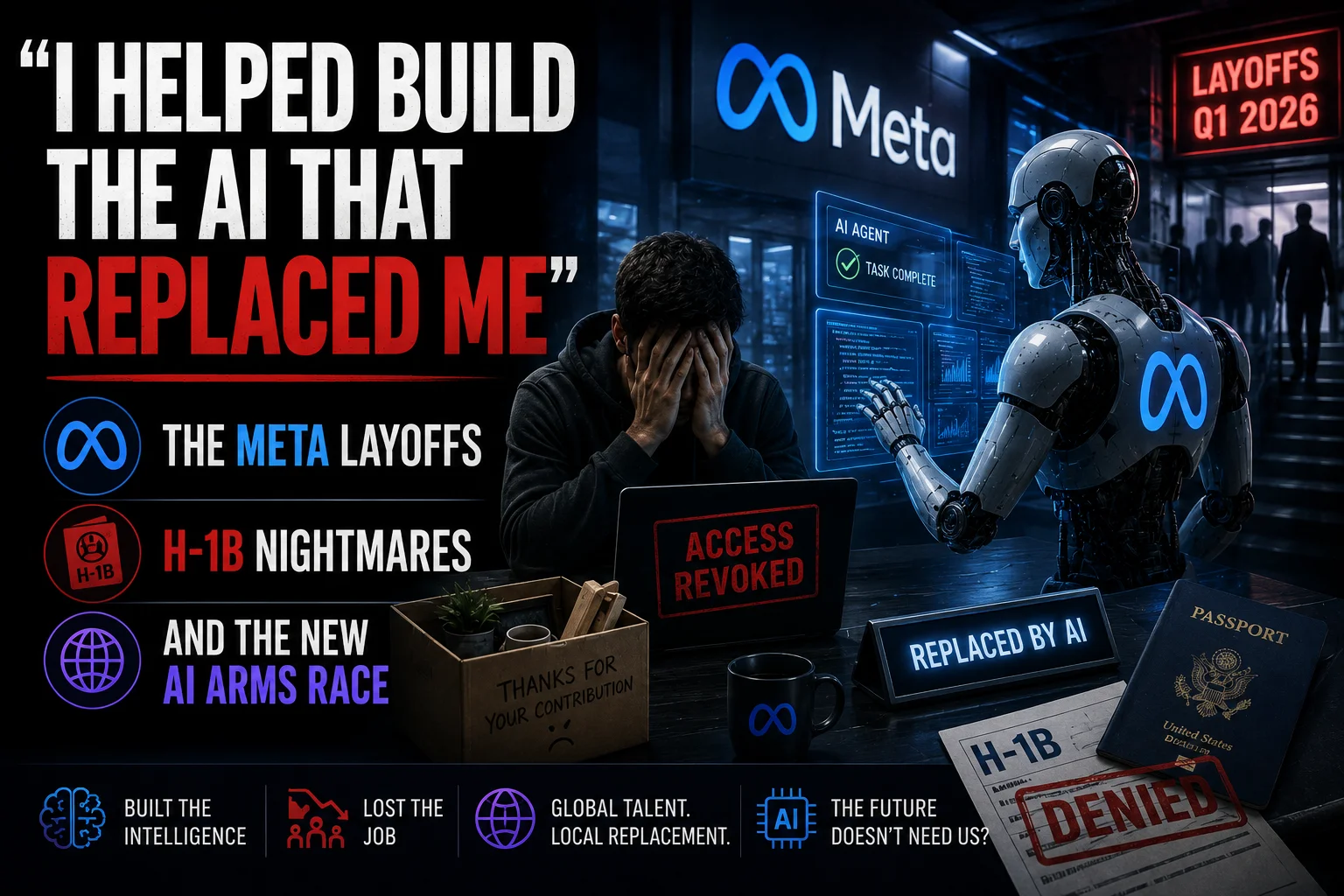
It starts like a typical Silicon Valley parable. A woman working at Meta. A company-wide "AI week." A mandate from leadership: pause your regular work, learn AI tools, build something useful. Her project gets approved. She spends months refining it alongside senior leaders and engineers. She pours her skill, her creativity, her humanity into making this internal tool work.
Then last week, she got the email.
4 AM. Singapore time. Her access card deactivated before she finished her first coffee.
She was laid off. And the tool she spent months building? It's still there. Still running. Still doing the work she used to do.
The X post sharing her story has crossed nearly a million views. And it went viral for one simple, terrifying reason: It feels like a metaphor for the entire white-collar job market right now.
We are not just building AI anymore. We are apparently training our own replacements. And if you think that's hyperbole, you haven't been paying attention to what just happened at Meta, what's coming from Google and OpenAI, and what it means for the 300,000 Indian professionals on H-1B visas whose clocks just started ticking.
This is the new AI arms race. And the ammunition is us.
Part 1: The Viral Story That Exposed Silicon Valley’s Dirty Secret
Let me rewind and give you the full picture of that viral claim, because the details matter more than the headline.
According to an X post by a user named Julian, Meta held a company-wide "AI week" several months ago. Regular work was paused. Employees were instructed to familiarize themselves with AI tools and workflows. By the end of the exercise, they were expected to create early versions of internal AI products.
Julian's wife was one of those employees. Her project was approved. She spent months developing it alongside senior leadership and engineers—all while quietly fearing that the very tool she was building could eventually replace her own role.
Fast forward to May 20, 2026. Meta began sending termination emails. Thousands of workers received notices as early as 4 AM local time. Julian's wife was among them.
"Fast forward to today: She's canned," the post read.
Now, let me be transparent with you: the specific claim about that exact sequence of events at Meta has not been independently verified. But here's the thing—it doesn't need to be. The reason this story has exploded across social media isn't because people believe every detail. It's because it feels true. It captures something real about the anxiety coursing through every tech office right now.
And then Mark Zuckerberg made it worse.
Leaked Audio: "We're Studying You"
While the viral X post was circulating, Yahoo Finance published a report on leaked audio from an April 30, 2026 Meta all-hands meeting. And what Zuckerberg said on that tape is frankly astonishing.
According to the leaked audio, Zuckerberg told employees: "The AI models learn from watching really smart people do things. The average intelligence of the people who are at this company is significantly higher than the average set of people that you could do tasks." He added that having internal employees build tools would "dramatically increase our model's coding ability faster than what others in the industry have the capability to do".
Let me translate that from corporate-speak to English: You are the training data.
Jason Calacanis, host of "This Week in Startups," called it "a really bad look for Zuck to be doing these profound layoffs after forcing everybody to do like AI-first hackathons." He paraphrased the underlying message as: "Listen, we're studying you to figure out how to make this all more effective because you're all so brilliant. It will result in more jobless".
The operative phrase there is "more jobless."
Zuckerberg didn't try to hide the logic. He articulated a productivity flywheel in which the workforce produces both output and the data to automate that output. Trade headcount for compute. Turn the remaining employees into a proprietary training corpus.
This is the quiet part, and he said it out loud.
The Numbers Behind the Bloodbath
Let me give you the scale of what Meta actually did, because the viral story is just one thread in a much larger tapestry.
On May 20, 2026, Meta began laying off approximately 8,000 employees—roughly 10% of its workforce. But that's not the whole story. Simultaneously, the company reassigned another 7,000 employees to AI-focused initiatives. Add those together, and you're looking at roughly 20% of Meta's workforce being either cut or forcibly moved into AI roles.
And the company also canceled 6,000 open job positions that had been planned for recruitment.
Combine all three—layoffs, forced reassignments, and canceled openings—and Meta effectively reduced its headcount footprint by approximately 14,000 positions.
But here's what makes this different from the 2022-2023 layoffs: it's not about saving money.
Meta just reported Q1 2026 revenue of 56.31billion,up3356.31billion,up33125-145 billion to pay for AI infrastructure.
This isn't a cost-cutting exercise. This is strategic restructuring. Meta is spending billions on AI while cutting thousands of people. The money isn't disappearing—it's being redirected from human salaries to compute clusters.
Zuckerberg reportedly told employees not to expect more "company-wide" layoffs this year, but he left room for targeted cuts. And internal chatter suggests more rounds are coming—possibly as soon as August.
The H-1B Clock: What the Viral Story Didn't Tell You
The original viral post got most of the attention. But a secondary story—equally heartbreaking, equally important—has been circulating alongside it.
A startup founder posted on X about an Indian engineer at Meta who received the layoff email at 11 PM Bengaluru time. His wife is on an H-4 dependent visa. His kid is in 3rd grade in Seattle. His H-1B clock just started ticking—60 days to find a new job or leave the country.
"This is what AI transformation actually looks like for 2 lakh Indians abroad," the founder wrote. "AI impact on Indians abroad is highest".
Let me put that number in perspective. Over 300,000 Indian professionals currently work in the US on H-1B visas. They account for over 70% of all active H-1B visa holders. When Meta cuts 8,000 people, a significant percentage of those are visa holders from India, China, and other countries.
Sixty days.
That's what separates "building the AI that replaces you" from "packing up your kid's 3rd-grade life and leaving Seattle."
One laid-off Meta employee, Gary Tay, wrote on LinkedIn: "Yesterday I was training up my new pod engineer... Today I'm laid off. 3,544 days (9 yrs, ~9 months). Hired in London, retrenched in Singapore. This year was exceptional. Spent a huge amount of time retraining myself with AI and developing systems for the teams. Speed up workload by 2-300% while still keeping SLA with the world's largest clients. AI is here to stay, apparently the human isn't".
That last line. Read it again.
"AI is here to stay, apparently the human isn't."
This is not just a story about job losses. This is a story about the dismantling of a certain kind of career—the stable, predictable, "learn to code and you'll always have work" career that defined the last twenty years.
The New AI Arms Race: Agents, Glasses, and Infinite Context
Okay, let me zoom out from the Meta drama for a minute, because the technology driving these layoffs is moving just as fast as the pink slips.
Google's Universal Agent
At Google I/O 2026, the company laid out its vision for Gemini as a "Universal Assistant" —an AI that operates across your entire digital life. Search, Android, Chrome, Workspace. All connected. All powered by the same model.
Citi released a report following the event, maintaining Alphabet as a top pick and noting that Gemini now processes 3.2 quadrillion tokens per month, with over 900 million monthly active users. Those numbers are staggering. They represent an AI footprint that rivals Google Search itself.
But the real headline from I/O was Android XR—Google's revived smart glasses project, built in partnership with Samsung and eyewear brands Gentle Monster and Warby Parker. Two versions are coming: one with audio-only assistance (think Meta's Ray-Bans), and one with actual display capabilities that put information in your field of vision.
The use cases Google demoed are genuinely useful: real-time translation as you walk past a foreign-language sign, restaurant reviews appearing as you glance at a storefront, text messages read aloud while you're on the move.
But here's what keeps me up at night: these glasses are always on, always watching, always feeding data back to Gemini. The same Gemini that just absorbed 7,000 Meta employees' workflow data to learn how to code better.
OpenAI's Million-Token Gambit
While Google was showing off glasses, OpenAI was quietly teasing its next major release. In early March 2026, the company posted a cryptic message on X: "5.4 sooner than you think".
The speculation centers on GPT-5.4, which is expected to feature a context window of more than 1 million tokens—more than double the 400,000-token limit in GPT-5.2. Some leaks suggest it could go as high as 2 million tokens, putting it in direct competition with Google's Gemini 3.1 Ultra.
To put that in perspective: a 1-million-token context window means the model can process all three volumes of "The Lord of the Rings" in a single session. Or an entire codebase. Or an employee's entire year of Slack messages and Jira tickets.
You see where this is going.
Telegram's AI Bots: Reading Your Messages
And then there's Telegram. A new server based on the Model Context Protocol (MCP) now allows AI assistants to connect directly to Telegram accounts. The capabilities include:
-
Listing dialogs and checking for unread messages
-
Marking conversations as read
-
Retrieving messages from specific chats
-
Sending draft responses on your behalf
The prompt examples are even more telling: "Check for any unread important messages in my Telegram" and "Monitor specific chat for updates about [topic]".
These are not science fiction features. These are real, shipping products. AI agents that read your messages, prioritize your conversations, and respond to people as if they were you.
And if they can do that? They can do a lot of other things too. Like triage customer support tickets. Or manage project workflows. Or, apparently, replace the person who built them.
The German Breakthrough You Haven't Heard About
Before I wrap up this section, I want to highlight one more story that hasn't gotten enough attention. A German startup called Lepto, founded by Empa researcher Elena Mavrona, has developed microscopic terahertz filters—thinner than a virus—that are poised to revolutionize 6G, satellite tech, and medical imaging.
This matters because AI needs data. And the next generation of wireless technology (6G) will generate incomprehensible amounts of it. The terahertz spectrum—which sits between microwaves and infrared light—has been notoriously difficult to work with because the filters required are so small and precise.
Lepto claims to have cracked it. Their filters are thinner than a virus and can manipulate terahertz radiation with unprecedented precision.
What does this have to do with job losses? Everything. Because the physical infrastructure of AI—the servers, the networks, the sensors—is getting exponentially more capable. The constraints that have historically protected certain jobs (like "you can't automate this because the data isn't there yet") are dissolving faster than anyone predicted.
Part 3: The White-Collar Anxiety No One Wants to Name
Let me get personal for a moment.
I have been writing about technology for long enough to remember when "automation" meant factory robots and self-checkout kiosks. It was something that happened to other people—people in manufacturing, retail, logistics. The white-collar world was safe. Creativity, strategy, management—these were fundamentally human domains.
That wall just collapsed.
The viral Meta story is resonating because every knowledge worker sees themselves in it. You've been asked to "learn AI tools" at your job, haven't you? You've been encouraged to "embrace automation" and "work smarter." Maybe you've even built a few automations yourself—little scripts, little workflows, little efficiencies that made your job easier.
And somewhere in the back of your mind, a quiet voice whispers: "If this gets too good, what do they need me for?"
That voice isn't paranoia anymore. It's pattern recognition.
The "Efficiency Narrative" Has Changed
The 2022-2023 layoffs were framed as corrections. Tech had overhired during the pandemic. Interest rates were rising. The economy was cooling. It was painful, but it followed a recognizable logic.
The 2026 layoffs are different. Meta is laying people off while revenue is up 33% and profit is up 61%. They are not in trouble. They are reallocating.
Zuckerberg reportedly framed the quarter as the launch of "our first model from Meta Superintelligence Labs" on the path to "personal superintelligence for billions of people". The all-hands quote tells you how he plans to pay for it: trade headcount for compute.
The new narrative isn't "we're cutting costs to survive." It's "we're investing in AI, and that means we need fewer of you."
The 60-Day Problem
For H-1B visa holders, this isn't abstract. The Department of Homeland Security rules give laid-off workers 60 days to find a new job, change their visa status, or leave the country.
Sixty days to interview, negotiate, and onboard—while competing with thousands of other suddenly unemployed tech workers.
Some will try to switch temporarily to B-1 or B-2 visitor visas to buy more time. But that's a stopgap, not a solution. The clock is real. The anxiety is real. And the stories of people packing up their families and leaving the only country they've called home for a decade are already circulating.
Gary Tay, the Singapore-based Meta engineer I quoted earlier, put it bluntly: "I'll be reassessing my career options in the next few months".
For someone who spent 9 years at Meta and 15+ years in big tech, "reassessing career options" is not a phrase you expect to write in your forties.
Part 4: What Happens Next? Three Scenarios
Let me game this out for you. I see three possible futures unfolding from this moment.
Scenario One: The Efficiency Win
In this scenario, the Meta layoffs work exactly as Zuckerberg intends. The 7,000 employees reassigned to AI roles build powerful internal tools. The 8,000 laid-off workers are absorbed by other companies (many of which are also automating aggressively). Productivity per remaining employee skyrockets. Meta's margins expand. Other tech companies copy the playbook.
The result: a smaller, more efficient tech workforce. Fewer jobs overall, but higher pay for the ones that remain. A two-tier system emerges: AI-adjacent roles (engineers who train, tune, and deploy models) and everything else (which slowly atrophies).
Probability: High. The financial incentives are too strong, and Meta's competitors are already moving in the same direction.
Scenario Two: The Backlash
In this scenario, the viral stories trigger something real. Regulators in the US and EU take notice of the H-1B crisis. Lawsuits emerge around the use of employee data to train replacement AI. Public sentiment turns against the tech industry in a way it hasn't since the "techlash" of the late 2010s.
Some companies reverse course—not because they want to, but because the reputational damage and legal risks outweigh the efficiency gains. A "human-centered AI" movement emerges, demanding transparency around which jobs are being automated and what happens to displaced workers.
Probability: Medium. The H-1B angle is particularly potent. Over 300,000 Indian professionals in the US have families, communities, and political connections. If enough of them lose their status, there will be consequences.
Scenario Three: The Acceleration
This is the scary one. In this scenario, the Meta layoffs are just the beginning. The AI capabilities I described—Google's universal agent, OpenAI's million-token context, Telegram's message-reading bots—all converge faster than expected.
It's not just coding jobs that disappear. It's project management. It's customer support. It's data analysis. It's a huge swath of the white-collar economy.
The result is not gradual workforce reduction but structural unemployment in knowledge sectors that have never experienced it before. Governments scramble to respond. Universal basic income goes from academic theory to urgent policy debate. The social contract between workers and employers is fundamentally renegotiated.
Probability: Low in the short term, higher than you think in the medium term. The technology is moving faster than the institutions that govern it. That gap has never closed gracefully.
What You Can Actually Do Right Now
I don't want to leave you with just anxiety and speculation. So let me give you some concrete, actionable advice.
If You're a Tech Worker
Document everything. The workflows you've automated, the tools you've built, the efficiencies you've created—these are not just accomplishments. They are evidence of your value. If your company is going through an "AI transformation," you want to be seen as the person who enables the transformation, not the person who gets transformed out of a job.
Build your external brand. The 60-day H-1B clock is a nightmare. But the people who survive these transitions best are the ones who have networks, portfolios, and reputations outside their current employer. Write. Speak. Contribute to open source. Make yourself findable.
Learn the AI stack. I know, I know—you're tired of hearing "learn to code" and now it's "learn AI." But here's the difference: you don't need to become a machine learning researcher. You need to understand how to use these tools, evaluate their outputs, and integrate them into workflows. That skill set is currently under-supplied and highly valued.
If You're a Manager
Be honest with your team. The worst thing you can do right now is pretend nothing is changing. Your team knows about the layoffs. They've seen the viral posts. They're scared. Acknowledge it. Name it. And then talk about what you're doing to protect them—even if that answer is "I'm not sure yet."
Advocate for retraining, not just replacement. The 7,000 Meta employees who got reassigned to AI roles are the lucky ones. If your company is planning layoffs, push for internal mobility programs, severance packages that include retraining stipends, and outplacement support.
Rethink your hiring. The era of "hire 10 juniors and train them up" is ending. The era of "hire 2 seniors who can leverage AI to do the work of 10" is beginning. Adjust your expectations accordingly.
If You're a Policy Advocate
Pay attention to H-1B. The 60-day grace period was designed for a world where laid-off workers could reasonably find new jobs. That world may no longer exist. Extending the grace period, creating new visa categories for displaced workers, or reforming the green card backlog would have enormous impact.
Demand transparency. Companies should be required to disclose when they use employee data to train AI systems, especially when those systems are used to automate the employees' own roles. The Meta all-hands leak suggests this is already happening. It should be disclosed, not leaked.
Start the UBI conversation now. I'm not saying we need universal basic income tomorrow. But the conversation needs to happen before the crisis, not after. The fact that it's still considered fringe political discourse is a failure of imagination.
The Bottom Line (Human to Human)
Here's what I genuinely believe after spending way too many hours reading layoff notices and leaked memos.
The viral Meta story is not an outlier. It is a preview.
We are entering a phase of AI deployment that is fundamentally different from what came before. The first wave was about automation alongside humans—tools that made us faster, better, more efficient. The second wave, the one we're in right now, is about automation instead of humans—replacing entire roles, not just augmenting tasks.
The people who built the first wave are now being eliminated by the second. That's the bitter irony at the heart of the viral post. The engineers who automated customer service are now being automated themselves. The project managers who streamlined workflows are now being streamlined out of existence.
This is not a bug. It is a feature. It is the logical endpoint of a system that views labor as a cost to be minimized, not a capability to be cultivated.
I don't have a tidy solution for you. I don't have a "5 steps to AI-proof your career" list that actually works. What I have is a conviction: the only sustainable response to AI displacement is to build things that AI cannot do alone.
That doesn't mean "creative work" or "emotional labor" or any of the other fuzzy categories we reach for when we're uncomfortable. It means work that requires accountability, judgment, and the willingness to be wrong—three things that current AI systems are structurally incapable of providing.
An AI can write a report. It cannot sign off on it.
An AI can triage a customer complaint. It cannot apologize on behalf of the company.
An AI can generate code. It cannot explain to a non-technical stakeholder why that code is the right solution, what trade-offs were made, and what could go wrong.
These are not incidental gaps. They are structural features of the technology. And they are where human value will concentrate in the coming years.
So yes, the Meta layoffs are terrifying. Yes, the viral story is dystopian. Yes, the H-1B clock is cruel.
But the answer is not to fear the AI. The answer is to become the person who can do what the AI cannot.
Build your judgment. Cultivate your accountability. Take responsibility for outcomes. And never, ever forget that the people writing the layoff emails are also, someday, going to receive them.
The AI arms race is here. The question is not whether you will be replaced. The question is whether you will be ready for whatever comes next.
*What do you think? Is the viral Meta story a one-off or a harbinger? Have you seen similar dynamics at your own company? And for those on H-1B visas—what would actually help right now? Drop a comment. I read every single one.*
Key Resources & Further Reading: