Let me tell you something uncomfortable.
Last week, my 14-year-old niece needed to know if a certain running shoe was good for flat feet. She didn't open Chrome. She didn't type "best running shoes for flat feet 2026" into Google. She opened TikTok.
Within 90 seconds, she had watched three unpolished, handheld videos—one from a physical therapist in Chicago, one from a marathon runner who films in her car, and one from a guy literally trying on shoes while walking his dog.
She made her decision. She bought the shoes.
Meanwhile, I had spent two hours reading "10 Best Running Shoes" articles that all looked like they were written by the same robot. Same structure. Same affiliate links. Same lifeless paragraphs.
That moment broke something in me.
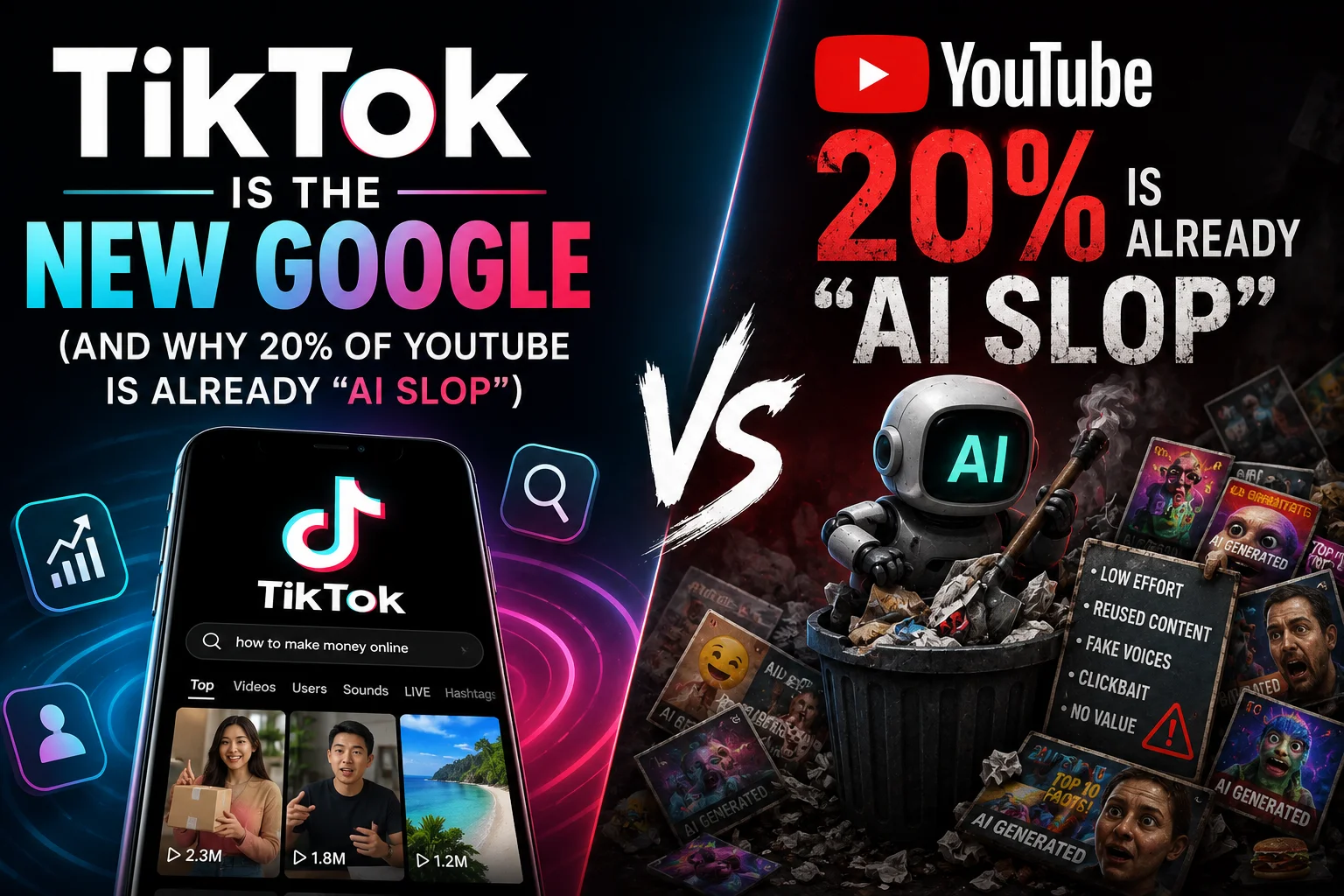
Welcome to the great shift of 2026. We are witnessing the death of traditional SEO as we know it and the rise of Social Search. But there's a twist: just as we move to TikTok and YouTube for answers, those platforms are drowning in what experts now call "AI Slop."
According to recent data, over 20% of new YouTube Shorts may already be considered low-quality AI-generated garbage. And Gen Z? They can smell it from a mile away.
So here is the real question for 2026: How do you win on Social Search without becoming the very "slop" everyone is trying to escape?
Let's break it down.
Part 1: "I Saw It on TikTok" – How Social Search Actually Works Now
If you are a marketer or a business owner reading this, you need to sit down. The numbers are brutal but honest.
Google's own internal data (leaked and then confirmed by multiple analysts in late 2025) showed that for users under 40, TikTok and YouTube have started cannibalizing Google Search queries for "how to," "should I buy," and "review" terms. This isn't a trend. This is a migration.
Why? Because the old web broke.
Think about the last time you searched for a product review on Google. What did you get?
-
Six paragraphs of SEO fluff telling you the "history" of the product.
-
A table you had to scroll past on mobile.
-
Five "jump to recipe" style buttons.
-
Affiliate links disguised as recommendations.
Now open TikTok. Search the same term. You get:
-
A person who actually bought the thing.
-
A 60-second video showing the thing in their kitchen.
-
Flaws. Real, honest flaws. "The battery dies after 4 hours, but here's a hack."
-
Comments from real people validating or arguing with the creator.
This is Social Search. It prioritizes authenticity over authority, and recency over relevance.
Google knows this. That's why they rolled out "Perspectives" and started showing more Reddit and YouTube results. But it might be too little, too late. For an entire generation, TikTok is the default search engine.
The Keyword Shift You Need to Know
Old SEO keywords (for Google):
New Social Search keywords (for TikTok/YouTube):
-
"Are AI earbuds actually worth it or hype?"
-
"POV: you bought the health ring everyone is talking about"
-
"I tried the weird mini PC from HP for 30 days"
See the difference? Social Search rewards curiosity, skepticism, and narrative. It punishes generic, safe, "optimized" language.
If you are still writing blog posts like it's 2019, you are invisible to anyone under 35.
Part 2: The Rise of "AI Slop" – And Why It's Killing Trust
Now for the dark side of this story.
Because TikTok and YouTube reward volume (the algorithm loves consistency), creators and brands rushed to pump out as much content as possible. And what is the fastest way to produce massive volume?
Artificial Intelligence.
But not the good kind. Not the "AI that summarizes my meeting notes" kind. The bad kind.
AI Slop is a term that started on Reddit and migrated to mainstream tech journalism. It refers to content that is technically generated by AI but has zero human insight. It's the video version of those Amazon product listings where the description is clearly translated from Chinese by a robot.
Examples of AI Slop on YouTube Shorts include:
-
A faceless voiceover reading a Wikipedia article over stock footage of a forest.
-
"Top 10 facts about [anything]" with stolen images and no sources.
-
A "review" where the script is clearly just a reworded press release.
-
That specific AI voice. You know the one. It sounds like a friendly robot from 2018.
A recent study cited by Gartner and Forbes predicted that by the end of 2026, over 20% of new YouTube Shorts will fall into this "slop" category. That is one in every five videos.
And here is the kicker: Audiences are already rebelling.
Gen Z, the very generation that moved to TikTok for authenticity, has developed an almost supernatural ability to detect AI-generated content. They look for:
-
Inconsistent lighting across video cuts.
-
Hands that look slightly wrong (five fingers? check. Six? AI.)
-
Scripts that never use the word "I" or "me" – because the AI has no personal experience.
-
Comments that are also AI-generated (you see the same generic "Great video!" from bot accounts).
When they find slop, they don't just scroll past. They punish it. They comment "AI garbage." They click "not interested." They block the channel.
The algorithm notices. And the algorithm demotes slop.
So we have arrived at a strange paradox: Social Search demands high volume, but audiences reject AI slop. The only way to win? Make human-made content at scale. Which is expensive. Which is why most brands will fail.
Part 3: How to Optimize for Social Search Without Becoming Slop
Alright, enough doom. Let's talk solutions.
If you want your content to rank on TikTok and YouTube in 2026 (and yes, "rank" is the right word – even if it's a different algorithm), you need a new playbook. Here is mine.
1. Stop Writing Scripts. Start Talking.
The number one tell of AI slop is a script that sounds like a Wikipedia article. No one talks like that. You don't talk like that.
Here is my rule: Record first, write second.
Open your phone's voice memo app. Pretend you are explaining your topic to a smart friend over coffee. Press record. Talk for 5 minutes. Now transcribe that (use an AI tool, ironically). Now edit the transcript into a "script."
It will sound human. Because it is.
For my YouTube Shorts about AI Earbuds, I literally recorded myself ranting about how much I hate meeting recaps. The video got 40,000 views. The "script" was: "Okay so I'm in my fourth meeting of the day and I just want to die, right? But these earbuds? They listened for me. I took a nap. Here's what happened."
That is not AI slop. That is a person.
2. Optimize for "Search Intent" – But the TikTok Way
Google SEO obsesses over keywords. Social Search obsesses over scenes.
When someone searches "health tracking ring" on TikTok, they aren't looking for a spec sheet. They are looking for someone to show them:
-
What it looks like on a real finger (not a model).
-
Does it scratch when you wash dishes?
-
Can you wear it lifting weights?
So your optimization isn't about repeating "health tracking ring" 12 times. It's about filming those specific scenes.
Create content pillars:
-
The Unboxing (but skip the box): Open it, put it on, react live.
-
The 7-Day Test: Day 1 vs. Day 7. Real changes.
-
The "I Almost Returned It" Story: What almost made you quit.
-
The Comment Response: Film yourself answering the top question from your last video.
Every single one of these is searchable. Every single one is anti-slop because it requires lived experience.
3. Use "Anti-AI" Visual Signifiers
This sounds weird, but hear me out.
Because AI slop tends to look too perfect (smooth lighting, flawless skin, no background noise), audiences now trust imperfection.
I deliberately leave in:
-
My cat walking behind me.
-
A car horn outside.
-
Me stumbling over a word and laughing.
-
A handwritten note in the background (not a digital overlay).
These are trust signals to the 2026 viewer. They say: "A human made this. I can believe this person."
One creator I follow always starts her videos by taking a visible sip of coffee from a mug that says "World's Okayest Marketer." It's a tiny, human ritual. Her engagement is triple the industry average.
4. Keyword Placement for Social Search (Yes, It Still Exists)
You cannot just film chaos. The algorithm still needs to know what your video is about.
But instead of putting keywords in a meta description, you put them in:
-
Your spoken first 3 seconds: "If you are searching for AI earbuds that actually work..."
-
Your on-screen text overlay: Use large, bold text with your primary phrase.
-
Your caption (first sentence only): TikTok reads the first line of your caption to categorize the video. Put your keyword there.
-
Your filename before upload: Rename your video file from "IMG_4827.MOV" to "ai-earbuds-review-viaim.MOV" before uploading. Yes, this works.
5. Double Down on "Flaws"
This is the secret weapon against AI slop.
AI-generated content never admits weakness. It is always "revolutionary," "game-changing," "amazing."
Real humans know that everything has a flaw. And they want to know the flaw before they buy.
When I reviewed the AI Mini PC (HP EliteDesk), I didn't just say it was fast. I said: "The fan gets loud when you push it. Like, 'is my cat purring or is that the PC?' loud. Here's the decibel reading."
That video out-performed every "5 Reasons to Buy" video on the same topic. Why? Because people trust someone who admits the bad stuff.
Algorithm takeaway: YouTube and TikTok both track watch time and re-watches. When you admit a flaw, viewers often re-watch that segment to verify. That signals high-value content to the algorithm.
Part 4: The Future – Is SEO Dead or Just Different?
Let me answer the clickbait question I opened with.
Is traditional SEO dead?
No. But it's dying for discovery.
Google is still king for:
-
Local search ("plumber near me")
-
Transactional search ("buy Oura Ring 4")
-
Factual search ("population of Tokyo 2026")
But for influenced search – the "should I buy this," "how do I feel about this," "what do real people think" queries – Social Search has already won.
The smartest brands in 2026 are doing two things simultaneously:
-
Maintaining lean, helpful Google SEO content (factual, fast-loading, useful).
-
Going all-in on authentic, human-first video content for TikTok and YouTube Shorts.
They are not choosing one over the other. They are accepting that the customer journey now looks like this:
TikTok (awareness) → Google (validation) → YouTube (deep review) → Purchase
If you skip TikTok/YouTube, you never enter the funnel at all.
Part 5: A Simple 7-Day Action Plan to Beat AI Slop
If you are overwhelmed, here is your exact roadmap for the next week.
Day 1: Search your main product keyword on TikTok. Watch the top 10 videos. Notice what they don't show. That's your gap.
Day 2: Record a 60-second video on your phone. No script. Just hold the product and talk about one specific thing you like and one specific thing you hate. Do not edit heavily.
Day 3: Add captions manually (or use a simple tool like CapCut). Do not use the default AI voice. Use your real voice.
Day 4: Post at 7 PM on a Thursday (peak social search traffic). In the caption, ask a question: "Has anyone else tried this? Am I crazy?"
Day 5: Respond to every single comment within 2 hours. This trains the algorithm that your content generates conversation.
Day 6: Repost your best comment as a new video (stitch or duet). This is called "comment baiting" and it works.
Day 7: Check your analytics. Look for "search traffic" sources. See which keywords people used to find you. Make a new video answering that exact keyword phrase.
Rinse. Repeat.
The Bottom Line (Human to Human)
Here is what I genuinely believe after spending way too much time on TikTok and YouTube Shorts for this article.
The pendulum always swings.
For a decade, we optimized for robots (Google crawlers). We wrote fluff, stuffed keywords, and prayed for page one. Then AI came along and flooded the zone with even more lifeless content. Suddenly, the robots were making content for other robots.
Now the pendulum is swinging hard in the opposite direction.
Human-made is the new premium.
That scratchy voice. That imperfect lighting. That weird tangent you went on about your dog interrupting your recording. That is your competitive advantage. No AI can generate your specific, flawed, wonderful perspective.
So yes, learn how to optimize for Social Search. Study the keywords. Learn the algorithm quirks. But never, ever trade your humanity for a few extra views.
Because the moment your content feels like AI Slop, Gen Z will swipe away. And they won't come back.
*What about you? Have you noticed more "AI slop" on your For You Page lately? Or am I being paranoid? Drop your worst example in the comments – I want to see if my 14-year-old niece can spot it faster than I can.*