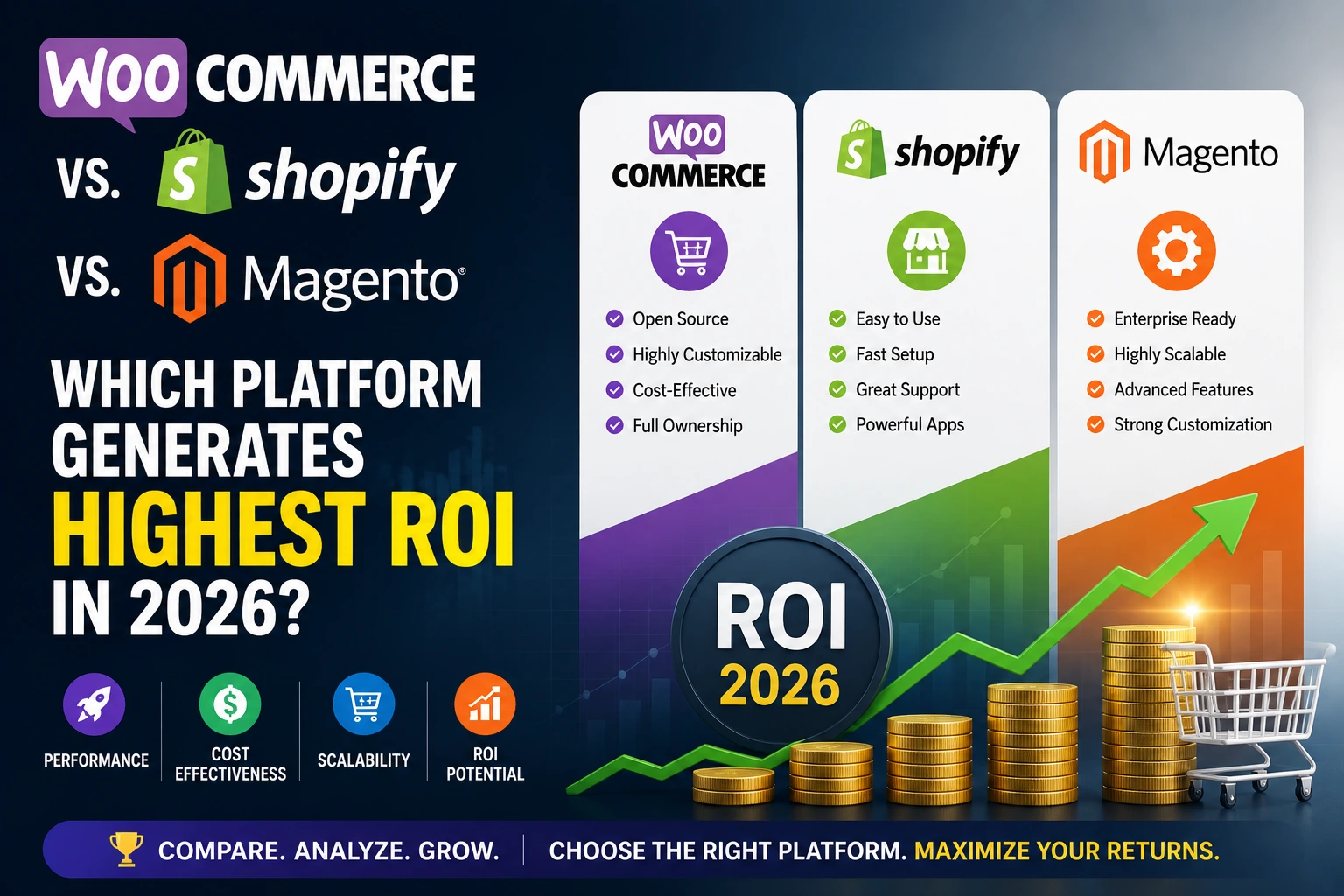
Let’s be real for a second. If you run an online store in 2026, you don’t care about fancy themes or how many payment gateways a platform supports. You care about one thing: return on investment. Every dollar you spend on hosting, apps, developers, and transaction fees needs to come back with profit.
The three biggest names in eCommerce today are still WooCommerce, Shopify, and Magento. But they work very differently for your bottom line. Choosing the wrong one can burn thousands of dollars a year without you even realizing it.
So let’s walk through each platform from a pure ROI angle. No fluff. No buzzwords. Just what really matters for your store in 2026. And if you’re looking for professional help to maximize your returns, you can always explore our full range of ecommerce development services or a custom ecommerce design tailored to your brand.
Why ROI in eCommerce is different now
A few years ago, people picked a platform based on design or ease of use. That’s not enough anymore. Customer acquisition costs through Google and social media have gone up. Margins are tighter. And buyers expect faster shipping, better support, and seamless checkout.
Your platform affects all of that. It affects how much you pay monthly, how much you pay per transaction, how fast your site loads, and how easily you can rank on search engines without paying for every click. Many merchants don’t realize that the wrong platform choice quietly steals profits for years. That’s why comparing WooCommerce vs Shopify vs Magento through an ROI lens is more important than ever.
Before diving deep, it helps to understand what our services include when it comes to platform selection, migration, and ongoing optimization. A well-built store on the right platform almost always beats a poorly built store on the “best” platform.
WooCommerce: the silent ROI champion for hands-on owners
WooCommerce started as a simple plugin for WordPress. Today it’s everywhere. Almost forty percent of all online stores run on it. That’s not an accident. According to recent data from W3Techs, WooCommerce continues to lead the global eCommerce market share by a wide margin.
What you pay upfront and every month
The core WooCommerce plugin is free. You don’t pay a license fee. What you do pay for is hosting, a domain, an SSL certificate, and any premium extensions you might need. Hosting can range from very cheap shared plans to managed WooCommerce hosting that costs a couple hundred dollars a month. Kinsta and WP Engine are popular choices for stores that want better performance without hiring a dedicated sysadmin.
Payment processing fees are similar to other platforms. You usually pay around two point nine percent plus thirty cents per transaction unless you negotiate better rates through providers like Stripe or PayPal.
Where your money comes back to you
Because there is no monthly platform fee, every sale keeps more profit in your pocket compared to Shopify’s base plan. That adds up fast. If you sell two hundred orders a month, you’re saving over forty dollars monthly just in subscription fees.
You also own everything. Your data, your customer list, your content. That means you can build email lists, run retargeting campaigns, and create blog content that ranks on Google without paying extra for advanced features. Many WooCommerce store owners also turn to OptinMonster for lead generation and Yoast SEO for better search visibility.
SEO is another hidden ROI booster. WooCommerce runs on WordPress, which is built for content marketing. You can write product guides, comparison posts, and tutorials that bring in free organic traffic. Over time, that reduces how much you spend on ads. A well-optimized store can rank for hundreds of long tail keywords without paying a cent per click.
When WooCommerce hurts your ROI
The catch is time and technical know-how. You need to update the plugin, your theme, and WordPress itself. You need to manage backups and security. If you don’t enjoy that kind of work or don’t want to hire someone, those hidden hours eat into your returns.
Also, scaling a WooCommerce store to handle high traffic requires good hosting and sometimes a developer. That can cost more than simply upgrading to a higher Shopify plan. That’s where having a reliable development partner matters. A proper ecommerce development setup from the beginning prevents costly rebuilds later.
Who gets the best ROI from WooCommerce
Small to medium sized stores that already use WordPress. Stores that sell unique products where content marketing drives sales. And merchants who don’t mind learning basic site management or paying a developer occasionally.
If you stay on WooCommerce for two or three years, your total cost is usually much lower than Shopify. That’s where the long term ROI wins. Many store owners find that investing in a custom ecommerce design on WooCommerce gives them both visual appeal and operational savings.
Shopify: paying for simplicity and speed
Shopify is the opposite of WooCommerce in one big way. You pay a predictable monthly fee, and they handle almost everything else. Servers, security, updates, PCI compliance. You just log in and add products. According to Shopify’s own 2025 annual report, they now power over four million stores globally.
What Shopify costs in 2026
The basic plan starts around thirty nine dollars a month. The mid tier plan is just over a hundred dollars. The advanced plan is four hundred dollars monthly. There’s also Shopify Plus for large stores at two thousand dollars and up, which is used by brands like Gymshark and Allbirds.
On top of that, you pay transaction fees. If you use Shopify Payments, those fees are lower. If you use another payment gateway like PayPal or Stripe, Shopify adds an extra fee between half a percent and two percent. That extra fee can really hurt high volume, low margin stores.
Most stores also need a handful of apps for things like advanced reviews, loyalty programs, back in stock alerts, or subscription billing. The Shopify App Store has thousands of options, but those apps easily add another fifty to two hundred dollars monthly. Popular apps like Klaviyo for email marketing and Recharge for subscriptions work seamlessly but come with their own monthly costs.
Where Shopify gives you strong ROI
The biggest ROI benefit is speed to market. You can launch a professional looking store in a weekend. That means you start making sales faster than someone building a custom WooCommerce setup. Time really is money when you’re paying for inventory and ads.
Shopify also invests heavily in checkout conversion. Their one page checkout is known to convert better than most open source solutions. Studies from Baymard Institute show that unnecessary checkout steps kill over twenty percent of potential sales. Shopify’s streamlined flow directly raises your revenue from the same amount of traffic.
Another hidden ROI win is Shopify Audiences. It helps lower your ad costs on Facebook and Google by sharing anonymized buyer data. For stores spending thousands on ads, that alone can cover the monthly subscription fee. Some merchants report a fifteen to twenty percent drop in cost per purchase after enabling Shopify Audiences.
When Shopify eats into your ROI
The problem starts when you need advanced features. Want to sell internationally with different currencies and domains? That requires a higher plan. Want to automate complex discount rules or wholesale pricing? That often needs a paid app like Bold or Wholesale Club.
Also, if you ever want to leave Shopify, moving your data and customer history is painful. That lock in means you might stay longer than you should just because migration costs are high. That’s why some stores eventually migrate to WooCommerce or Magento and need a full ecommerce development team to handle the transition.
Who gets the best ROI from Shopify
New store owners who want to launch fast and don’t have technical skills. Stores doing between fifty thousand and one million dollars a year where the monthly fee feels small compared to revenue. Also, brands that rely heavily on paid ads and can benefit from Shopify’s audience tools.
For a store doing one million in annual sales, the total Shopify cost including apps and fees might be around forty thousand dollars a year. That’s still good ROI. But above that revenue level, you start questioning whether you could save money elsewhere. Many successful stores eventually move to a more flexible platform with help from an experienced ecommerce design agency.
Magento: power for the big players only
Magento is a different beast. There’s a free open source version and a paid enterprise version called Adobe Commerce. Most serious businesses end up on the paid version because of the support and built in features. Adobe has continued investing heavily in Magento since acquiring it, and the 2026 releases focus heavily on AI powered product recommendations and B2B features.
What Magento really costs
The open source version has no license fee, but good hosting for Magento costs much more than WooCommerce hosting. You’re looking at two hundred to a thousand dollars monthly for a decent setup on providers like Nexcess or Cloudways. And you will need a developer. Magento is not beginner friendly. The learning curve is steep enough that most store owners need professional help.
Adobe Commerce starts around twenty two thousand dollars a year. That number climbs quickly based on your gross merchandise value. Many stores pay fifty thousand to over a hundred thousand dollars annually just for the license. Forbes reported that large Adobe Commerce implementations often exceed two hundred thousand dollars yearly when you factor in hosting, development, and extensions.
Then add hosting, developer salaries or contract work, and extensions. A fully managed Adobe Commerce store can easily cost over a hundred fifty thousand dollars a year to run properly.
Where Magento delivers unbeatable ROI
If you have a massive catalog with hundreds of thousands of products, Magento handles it better than anyone else. If you run a B2B business where customers need custom pricing, quote requests, and company accounts, those features come built into Adobe Commerce. You don’t need expensive third party apps. Magento’s native B2B module is considered the gold standard in the industry.
Magento also gives you complete control over performance. With the right hosting and development, you can serve pages faster than any SaaS platform. That speed improves conversion rates and SEO rankings. Google’s Core Web Vitals directly impact rankings, and Magento lets you fine tune every millisecond of load time.
For enterprise stores doing tens of millions in revenue, the ROI math flips. Paying a hundred thousand dollars a year to support fifty million in sales is nothing. The lost sales from platform limitations would cost much more. That’s why luxury brands like Harvey Nichols and Land Rover run on Magento.
When Magento destroys your ROI
For any store under five million dollars in annual revenue, Magento is almost always a bad financial decision. The development costs alone can wipe out your profit margin. Many small business owners try Magento open source thinking they’re saving money, then spend thousands on fixes and upgrades.
Even at ten million dollars, you need to carefully compare the total cost of Magento against Shopify Plus or a highly optimized WooCommerce store. In many cases, the simpler platforms still win on ROI. A poorly managed Magento store can actually lose sales due to slow performance and bugs that a smaller budget can’t fix.
Who gets the best ROI from Magento
Large enterprises with dedicated development teams. B2B wholesalers who need complex pricing and ordering workflows. And stores that have outgrown everything else and need absolute freedom to customize every part of the checkout and catalog.
For everyone else, Magento is like buying a commercial truck to drive to the grocery store. It can do the job, but you’re paying way too much for what you actually need.
So which platform actually gives the highest ROI in 2026?
There is no single answer that fits every store. But there is a pattern that helps you decide.
If you are just starting out and want to test products quickly, Shopify gives you the fastest path to positive ROI. You pay a bit more monthly, but you save on development time and headaches. The built in tools from Shopify and its app ecosystem mean you can focus entirely on selling.
If you already use WordPress and enjoy having full control, WooCommerce will give you higher long term ROI after the first year. The lack of monthly fees and the SEO advantages add up significantly over time. And you can always pair it with a custom ecommerce design to stand out from the competition.
If you are a large business with complex needs and a healthy budget, Magento’s raw power and built in B2B features make it worth the high cost. But only if you truly need what other platforms can’t offer. In those cases, professional ecommerce development is not optional, it’s essential.
In most real world cases for stores under one million dollars in annual sales, WooCommerce and Shopify are the only two worth considering. Between them, the highest ROI usually goes to WooCommerce for merchants willing to handle some technical work, and Shopify for those who prioritize simplicity over saving every possible dollar.
The best way to know for sure is to map out your expected sales volume, your technical skills or budget for hiring help, and your long term product catalog complexity. Run the numbers for your specific situation. That’s where the real answer lives.
And if you decide WooCommerce is the right path for your ROI goals, make sure you set it up on quality hosting with proper caching and security from day one. That small upfront investment pays for itself many times over in faster load times and fewer headaches down the road. Whether you need a full ecommerce development overhaul or just a fresh ecommerce design to improve conversions, the right foundation makes all the difference. You can also browse our full range of our services to see how we help merchants maximize their platform ROI every single day.