AI Anchors Are Here: How BBC's Helen Drew Avatar Changes Digital Media Forever
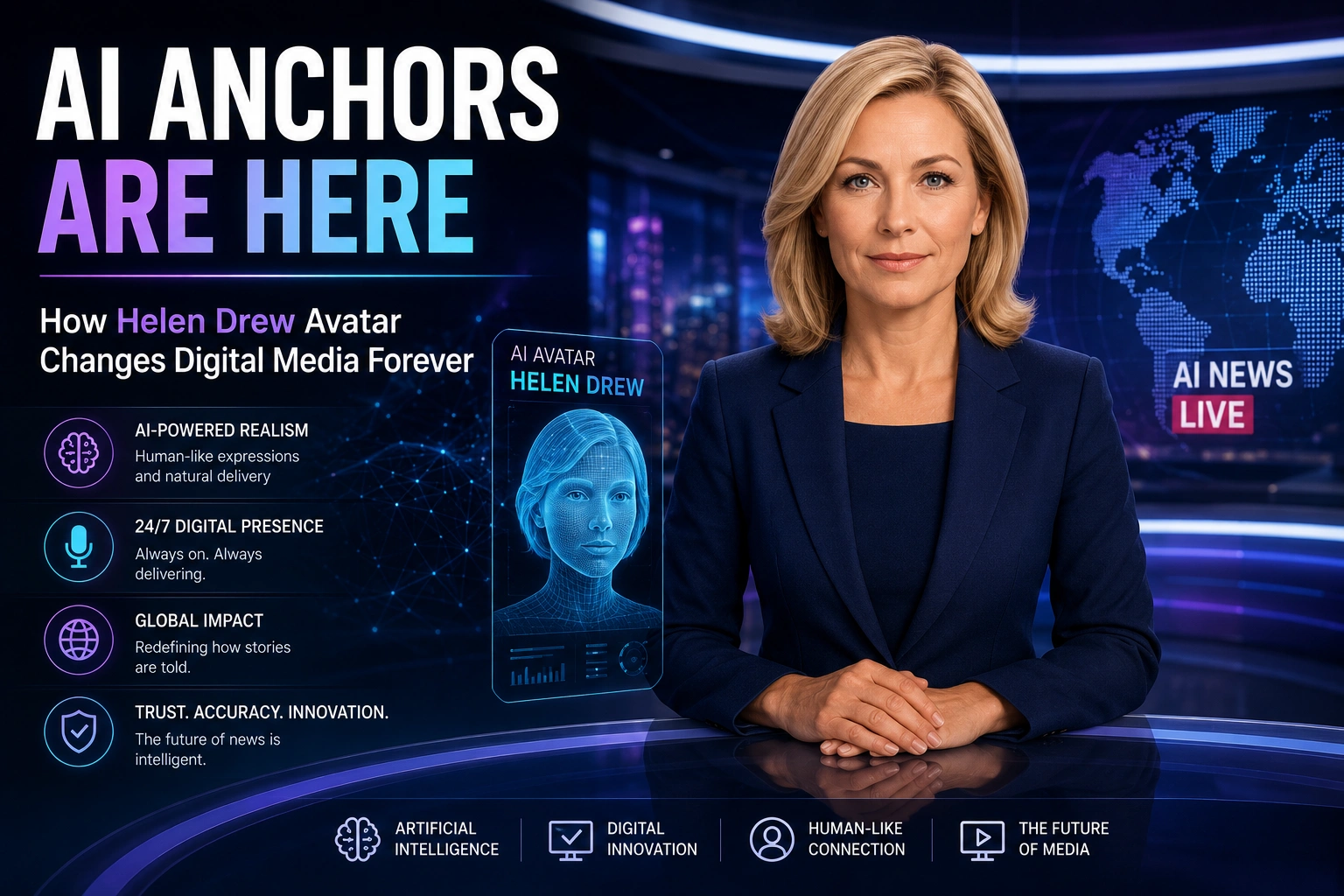
The news just read you. But the person reading it was never there.
In April 2026, an artificial intelligence company called Synthesia quietly created a digital avatar of BBC London's Helen Drew. Using just a handful of photos and a recording of her voice saying something completely different, they built a synthetic journalist that can deliver any script without a camera crew, without a studio, and without Helen Drew actually speaking a single word of what you hear .
This is not science fiction. This is not a deepfake prank. This is a mainstream news organization knowingly, willingly, and contractually allowing an AI clone of one of its journalists to exist.
The Helen Drew avatar signals something much bigger than a single BBC experiment. It marks the moment when synthetic media stopped being a novelty and started becoming a legitimate production tool for the world's most trusted news brands. And that changes everything about how we consume information, how we trust what we see, and how developers build the next generation of digital experiences.
Meet Helen Drew: The AI journalist everyone is talking about
Let me tell you exactly what happened, because the details matter.
Synthesia, a London-based AI firm that serves over seventy percent of the FTSE 100 companies including NatWest, Lloyds Bank, the NHS, and the United Nations, created an avatar of BBC London's Helen Drew . The company used a small collection of photographs and a voice recording of the journalist. The AI then learned her facial expressions, her lip movements, her mannerisms, and her vocal patterns.
The result is a digital human that can read any script you give it. The avatar looks like Helen Drew. It sounds like Helen Drew. It moves like Helen Drew. But Helen Drew never performed those words. She never stepped into a studio. She never pressed record.
The technology is not secret. Synthesia's knowledge base openly explains how their Personal Avatars work. Their Express-2 technology creates lifelike avatars from a single photo. The system generates natural body language that matches the spoken content, even though it never learned how the actual person moves in real life .
For lip sync quality, they recommend tight framing and good lighting. For best results, they suggest showing your teeth in the training photo. The entire process, from photo upload to working avatar, takes just minutes in most cases .
How the BBC is using AI beyond news anchors
The Helen Drew avatar is not the BBC's only AI experiment. The public broadcaster is moving fast.
In March 2026, BBC World Service launched five animated video episodes of its popular radio program Witness History, created entirely with generative AI tools . The first episode, "The World's First Labradoodle," dropped on YouTube. It was followed by animated versions of "Brazil's Biggest Bank Heist," "Ramesses II's Mummy Makeover," and other historical stories.
The animations were produced by 1UpMedia, a podcast-to-video studio that uses AI in all its projects. But here is the key detail. A human is always involved in the process to guide the AI. The company uses multiple different AI tools on each project, all with commercial licenses. And credit is always given to contributors and artists .
Fred Durman, Head of Business Development at BBC World Service, said the project uses generative AI to "give a second life to our original programming, enabling us to reach new audiences in a novel way" .
This is not replacement. This is amplification. The BBC is not firing journalists and hiring algorithms. They are using AI to extend the reach of existing human-produced journalism.
Exactly how AI journalist avatars are created
If you want to understand the technology, the best source is Synthesia's own documentation. They offer two methods for creating personal avatars in 2026.
Method one: From a single photo. This is the faster, newer approach using Express-2 technology. You upload a clear, well-lit photo of yourself from the waist up. The system generates your avatar within minutes. Your avatar can wear different outfits, appear in different backgrounds, and even perform actions in b-roll footage. Lip sync works best when the avatar is framed tightly in the scene .
You also need to record a consent video. This is not optional. The person represented by the avatar must record their own consent live, including a passcode displayed on screen. Avatars of public figures or anyone without explicit consent are not allowed .
Method two: From video footage. This is the legacy approach, still supported. You record between one and five minutes of continuous footage. Only one person should appear. The file can be MP4, MOV, or WebM up to 2GB. Your voice is cloned automatically during the process. Processing takes about one business day .
For enterprise customers, unlimited personal avatars are available. For smaller plans, you get between three and five free avatars depending on your subscription. Additional avatars cost around two hundred forty dollars per year .
The key limitation is control. Once your avatar exists, who decides what it says? Who approves scripts? How is synthetic content labeled? These questions are not fully answered yet.
The generation method: How Synthesia built Helen Drew
According to BBC reporting, the Helen Drew avatar was created using "a handful of photos and a recording of her voice saying something else entirely" . That final phrase is crucial.
The voice recording did not match the final script. The AI learned her voice from one set of words, then applied that voice model to a completely different script. This is called voice cloning, and it is the same technology that powers the most convincing deepfakes.
Laura Gonzalez, chief of staff at Synthesia, told the BBC that London has become a global melting pot for AI talent. "We have access to incredible talent coming from across Europe and worldwide, and we're seeing an influx of great US talent wanting to come to London," she said .
The company is already working on the next level. Youssef Alami Mejjati, head of research at Synthesia, described interactive training videos where you can raise your hand virtually and ask the avatar to explain a specific point. "While you're watching a training video, you could basically interrupt the video and say, 'Hey, I don't understand this specific point', and the avatar video can basically enhance that for you," he explained .
That is not a passive viewing experience. That is a conversation with a synthetic human.
Why this is sparking massive debate about media authenticity
Not everyone is celebrating. The rise of AI journalist avatars raises urgent questions about trust, consent, and the very definition of news.
The Nieman Lab, Harvard's prestigious journalism think tank, gathered twenty media experts to predict the future of news in 2026. Their consensus was sobering. Generative AI is making information "malleable" — capable of being reshaped, recontextualized, and potentially distorted in ways that are not lossless .
Robin Kwong, product director at Yahoo News, warned that transformations made by generative AI lose fidelity to the original. The loss can come from divergence from authorial intent, from inaccuracies introduced by hallucinations, or from straying from the original voice and style. "Content that becomes malleable loses some fidelity to the original," he wrote .
The BRAID UK project brought seventy people of all ages together with BBC experts to discuss AI and news at the Edinburgh Science Festival. Participants told researchers they felt poorly prepared for the disruptions AI is bringing. They wanted more guidance on tools and techniques to check information and recognize manipulation .
The same research highlighted a disturbing trend. Summarized news from chatbots is increasing in popularity. But news can be distorted due to inaccuracies introduced by AI assistants and AI-powered search engines. Bias can be introduced deliberately or accidentally, and this is very difficult to mitigate .
If an AI anchor makes a mistake, who is responsible? The journalist whose face was used? The news organization that deployed the avatar? The AI company that built the model? The answer is not clear. And in the vacuum of clarity, trust erodes.
The consent question that nobody has fully answered
Synthesia requires explicit consent. Their platform mandates a live consent video where the person being cloned speaks a specific on-screen passcode. You cannot upload a pre-recorded consent clip. The person must record it live, in real time, acknowledging exactly what they are approving .
But consent is not a one-time event. What happens when a journalist leaves the BBC? Does their avatar retire with them? Can they withdraw their likeness years later? What about uses they never anticipated, like appearing in an advertisement or a political message?
Technori, a technology news site, raised these exact questions when covering the Helen Drew announcement. They asked: Was the likeness licensed and can it be withdrawn? Who approves scripts and final cuts? How is synthetic content labeled on air and online?
The BBC has not fully answered these questions publicly. Neither has Synthesia. Neither has any news organization that is currently experimenting with AI anchors.
What this means for web developers and digital product builders
If you build websites, applications, or digital experiences, the AI journalist trend is not just a media story. It is a product roadmap.
Synthesia's API allows developers to generate videos programmatically. You can integrate AI avatars into your own applications. Customer support agents, training modules, personalized onboarding flows, and even eCommerce product explainers can now feature lifelike digital humans.
The underlying technology is accessible. Face synthesis, voice cloning, and real-time animation are available through APIs from ElevenLabs, HeyGen, D-ID, and others. You do not need to train your own models. You just need to integrate.
But with this power comes responsibility. If you deploy an AI avatar, you need clear labeling. You need consent from any person whose likeness you use. You need audit trails showing what the avatar said and when. And you need a kill switch to retire avatars when permissions expire.
The Coalition for Content Provenance and Authenticity (C2PA) has developed technical standards for labeling AI-generated content. Their metadata system attaches cryptographically signed provenance information to media files. Viewers can see exactly when, where, and how content was created. This is not a silver bullet, but it is a start .
The two paths forward for digital media
Nieman Lab's experts identified two possible responses to the rise of malleable, AI-generated content.
Path one: Lean in. Publishers can actively use AI to generate summaries, podcast versions, short-form videos, and personalized content. They can design content specifically to be molded by machines. This path embraces efficiency and reach, but risks losing authorial voice and trust.
Path two: Resist. Publishers can create experiences that resist malleability. Returning to print. Live journalism performances. Events that cannot be replicated or distorted by AI. This path preserves authenticity, but sacrifices scale and accessibility .
Most publishers will do both. The BBC is already demonstrating this hybrid approach. Witness History animations lean into AI for reach. The Helen Drew avatar experiments with synthetic presentation. But the core investigative journalism remains human, verified, and attributable.
Final thoughts on AI anchors and digital human media in 2026
The Helen Drew avatar is not the end of human journalism. It is not even the beginning of the end. It is a single experiment by a public broadcaster trying to understand a new technology.
But it is also a signal. The largest, most trusted news organizations in the world are now actively deploying synthetic media. They are not doing it secretly. They are announcing it publicly, explaining their methods, and inviting scrutiny.
That transparency is encouraging. It suggests that the worst dystopian futures — where fake anchors spread propaganda indistinguishable from real news — are not inevitable. Regulation, consent frameworks, provenance standards, and public awareness can all help.
For developers, the message is clear. The tools to build digital humans are available now. The question is not whether you can build them. You can. The question is whether you should build them responsibly.
If you are working on AI avatars, digital humans, or synthetic media experiences, prioritize consent, labeling, and user control. Your users will trust you more for it. And in an era of malleable information, trust is the only currency that matters.