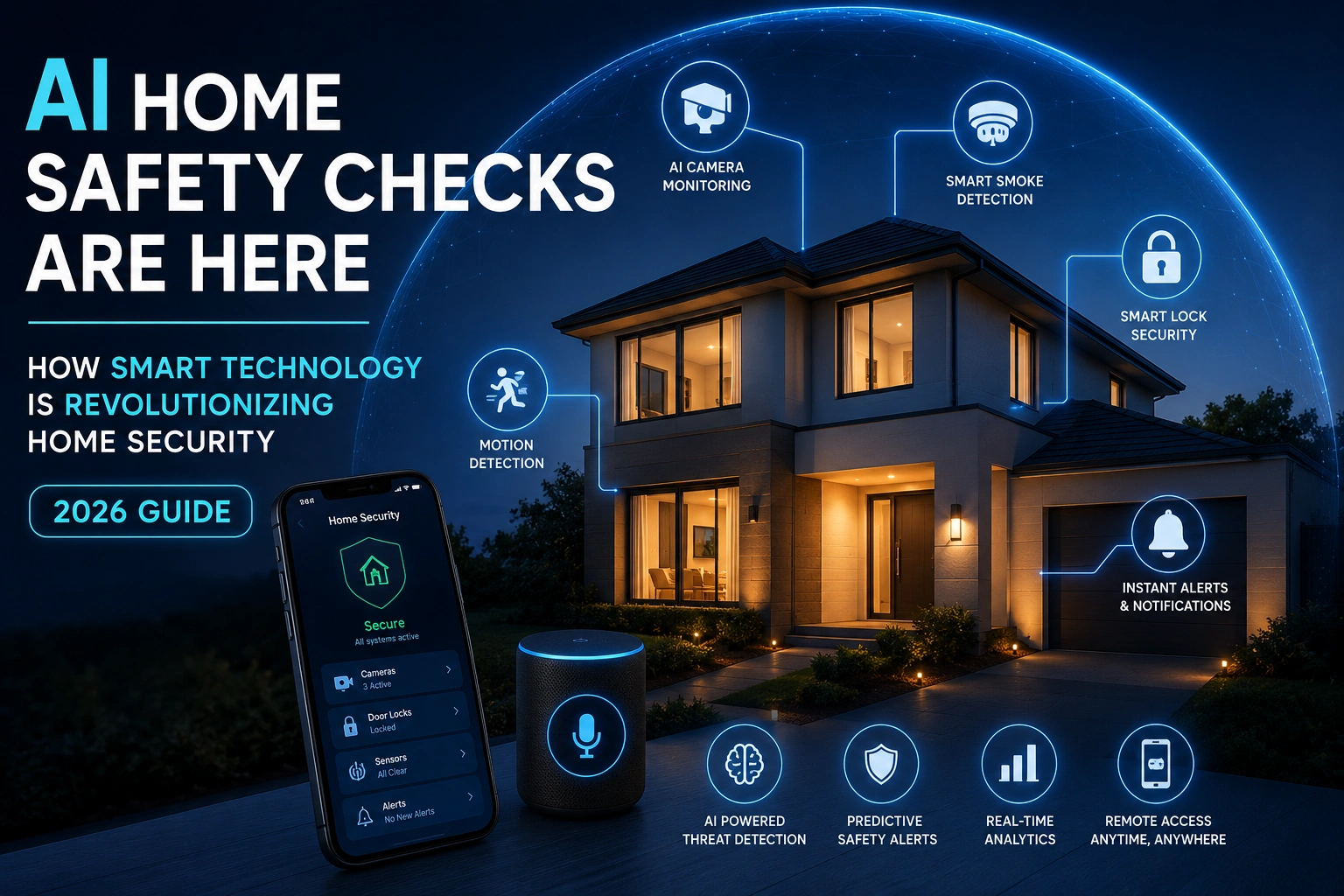
Your home is talking to you. You just are not listening yet.
For years, home security meant loud alarms and motion sensors that triggered every time a cat walked by. You learned to ignore the false alerts. Then one day, a real threat happened, and you almost missed it because the system cried wolf so many times.
That era is ending in 2026. Artificial intelligence has finally made home security smart enough to know the difference between your kid coming home from school and a stranger lurking around back. It can now check your home for weak spots automatically. It can warn you about unusual activity before anything bad happens. And it can do all of this without drowning you in notifications.
According to Trend Hunter's May 2026 tech roundup, "AI Home Safety Check" is emerging as one of the top trends in smart home technology. These tools identify vulnerabilities in your security setup using artificial intelligence, then give you a roadmap to fix them.
Let me walk you through exactly how this works, what new products just launched, and how you can make your home safer without losing your mind to false alarms.
What is an AI Home Safety Check?
Think of it as a security audit that happens automatically. Instead of hiring a consultant to walk around your property looking for weak spots, you answer a few questions or let sensors do the work. The AI analyzes your responses against millions of data points about break-ins, entry points, and common vulnerabilities.
The system then generates a personalized report. It might tell you that your back door lock is outdated. Or that your floodlights leave a dark corner near the garage. Or that your Wi-Fi signal dies near the side gate, leaving cameras offline.
Trend Hunter describes these tools as "questionnaire-based interfaces where users input details about their property, such as entry points, locks, lighting, and existing security measures". The AI analyzes everything and delivers practical recommendations.
Some newer systems go further. They use sensors and cameras to map your property automatically. No forms to fill out. Just real data about what is actually happening around your home.
What Ring just announced at CES 2026
The biggest news in AI home security dropped in January 2026. Ring unveiled a massive expansion of its ecosystem at CES, moving far beyond simple motion alerts.
The game changer is called AI Unusual Event Alert. Instead of buzzing your phone every time a car drives by, the system learns the daily routine patterns of your property. If something happens that does not fit that pattern, you get a specific alert.
Here is how Ring explains it. "AI Unusual Event Alert identifies and alerts you to activity around your home that may be out of the ordinary. By using Ring Video Descriptions, this new feature learns and adapts to everyday routine patterns at your property, so you're notified only when something unusual occurs, minimizing unnecessary alerts".
What counts as unusual depends on your home. If coyotes never visit your yard and suddenly a pack appears, the system recognizes that as abnormal and alerts you. If your teenager usually comes home at 3:30 PM and someone walks up the driveway at 2 AM, that triggers a different response.
Ring also introduced Active Warnings. Your cameras can now speak. Using computer vision, the camera analyzes a person's actions and location to deliver a tailored audio message. For customers using Virtual Security Guard, this offers a speedy deterrent message while a live agent reviews the footage.
Beyond Ring: The broader AI home security landscape
Ring is not the only player here. Alarm.com showed off major AI enhancements at ISC West 2026 that push the boundaries even further.
Their new AI Video Event Search lets you find specific moments using natural language. Type "package delivery yesterday" or "kids with bicycles today" into the search bar. The AI scans your saved video clips and finds exactly what you need. No more scrubbing through hours of footage.
Familiar Face Analytics allows customers to teach their doorbell to recognize up to five familiar faces. You get personalized alerts when these remembered individuals arrive at your property. It takes only one image to train the system.
For renters or people who do not want cameras inside, Arqaios introduced something completely different at CES 2026. Called ALLIE, it embeds AI and mmWave radar sensing into everyday electrical fixtures like power outlets, light switches, and air vents.
The system detects occupancy and safety issues without cameras or Wi-Fi signals. It is designed specifically for privacy. No one wants a camera watching them in the bathroom or bedroom. But mmWave radar can detect a fall without recording video. For the 62 million seniors at risk of debilitating falls, this is life changing technology.
How AI-powered home monitoring actually works
Under the hood, these systems use several technologies working together.
Computer vision analyzes video feeds in real time. The system can distinguish between a person, a vehicle, an animal, or a package. Open source projects like YOLO (You Only Look Once) have made object detection fast enough to run on consumer cameras. When combined with face recognition libraries, the camera knows whether the person at your door is family, a friend, or a stranger.
Pattern recognition learns what normal looks like for your specific home. Delivery trucks come at certain times. Kids leave for school at 7:30 AM. The gardener shows up on Tuesdays. The AI builds a model of your routine. Anything outside that model gets flagged.
Anomaly detection is the technical term for finding unusual events. Research projects like CCTView demonstrate real-time anomaly detection across multiple camera feeds, with response times under fifteen seconds. The system can spot unauthorized people, crowd formation, object abandonment, perimeter breaches, and even smoke or fire.
Reinforcement learning allows the system to get smarter over time. When you mark an alert as important or ignore it as noise, the AI learns. Future alerts become more accurate. Some academic projects have successfully integrated Q-Learning and Deep Q-Networks into IoT security systems for intelligent decision-making.
Automated security assessment tools explained
Here is where things get really interesting for homeowners who want to proactively improve safety.
Automated security assessment tools evaluate your property without requiring professional installation. You might answer questions about your home's layout, entry points, and existing equipment. Or sensors might do the mapping automatically.
The AI then generates a vulnerability map. This report highlights specific weak spots ranked by risk level. A first floor window hidden from street view might be high risk. A back door with an old lock might be medium risk. A dark pathway to the side gate might be low risk but easy to fix.
Recommendations are personalized. Instead of generic advice like "install motion lights," the AI suggests exactly where to place them and what brightness you need based on your property's unique characteristics.
Some enterprise platforms like HiveWatch take this concept even further. They unify physical security systems across large properties, reducing false alarms by ninety percent and cutting incident resolution time to twenty two seconds on average. For homeowners, similar principles apply but at a smaller scale.
The privacy question nobody wants to talk about
All this AI power requires data. Cameras watch. Sensors track. Algorithms analyze. That makes people uncomfortable, and rightly so.
The best AI home security systems in 2026 are designed with privacy as a feature, not an afterthought. Alarm.com emphasizes that customers "remain in control of how AI features are enabled and used". You can exclude specific cameras from search results or turn off facial recognition entirely.
Arqaios built their entire product around privacy. No cameras. No Wi-Fi tracking. Just mmWave radar that detects presence without identifying who you are.
Ring processes video locally on device for many AI features. Your footage does not live on some server forever. It stays on your hardware until you decide to share it.
Before buying any AI security product, read the privacy policy. Look for answers to these questions. Does video leave my home? Who can access my data? Can I delete my training history? What happens if the company gets hacked?
The honest providers answer these questions clearly. The ones hiding something will dodge or use vague language.
What this means for web and IoT developers
If you build web applications or IoT devices, the AI home security trend represents a massive opportunity.
Ring just opened their ecosystem with a new Ring Appstore. Third party developers can now create apps that integrate with Ring camera feeds for specific tasks. Pool safety monitoring. Pet behavior analysis. Package theft prevention. The APIs are available now.
The underlying technologies are accessible too. Open source projects demonstrate that a Raspberry Pi with a camera module, Flask backend, and YOLO object detection can create a functional AI security system for under one hundred dollars.
WebSocket connections enable real time video streaming to browsers and mobile apps. Firebase handles push notifications when threats are detected. Tailscale or similar VPN solutions secure remote access.
For developers, the barrier to entry has never been lower. You do not need to build everything from scratch. The components exist. Assembly is the value.
Putting it all together: your 2026 AI home security checklist
If you want to upgrade your home security with AI in 2026, here is a practical roadmap.
First, run an AI home safety check. Use a tool like the one Trend Hunter highlighted to identify your biggest vulnerabilities. Start with the highest risk items first.
Second, choose a platform. Ring works well for most homeowners because of the ecosystem breadth and the new AI features. Alarm.com offers more advanced analytics for power users. Arqaios is the privacy focused choice, especially for seniors or renters.
Third, enable smart alerts. Turn on AI Unusual Event Alert or similar features. Give the system a week to learn your routine. Then pay attention to what it flags. The first few unusual events might be things you forgot about. After that, the alerts become genuinely useful.
Fourth, integrate beyond security. The same sensors that detect intruders can detect water leaks, smoke, and temperature changes. Use them. A burst pipe damages your home more than most burglaries.
Fifth, review and improve quarterly. Run a new safety assessment every few months. Add sensors where the AI identifies weak spots. Remove what you do not use. An outdated security system is almost as bad as no system at all.
The bottom line on AI home security in 2026
Smart home safety checks are not science fiction anymore. They are shipping today. Ring, Alarm.com, and a dozen other companies have products on shelves right now that use artificial intelligence to make your home genuinely safer.
The false alert fatigue that plagued early security systems is finally being solved. Your phone will not buzz for every passing car or neighborhood cat. It will buzz when something unusual actually happens. That restores your trust in the system.
Automated security assessment tools take the guesswork out of home protection. You no longer wonder if your setup is adequate. The AI tells you exactly where the weak spots are and how to fix them.
Privacy remains a valid concern. But the best providers have built privacy controls into their products from the ground up. You can have AI powered protection without sacrificing your personal data.
Whether you are a homeowner looking for peace of mind or a developer building the next generation of security tools, the message is the same. AI home safety checks are here. They work. And they are only getting smarter.
Your home is already talking to you. It is time you started listening.