Key Takeaways:
-
The Agentic AI insurance market is projected to grow from 5.76billionin2025to5.76billionin2025to18.16 billion by 2030, a compound annual growth rate (CAGR) of over 25%.
-
Unlike traditional AI that merely analyzes data, Agentic AI autonomously executes multi-step workflows, from underwriting to claims processing.
-
Industry leaders like Majesco and Cytora are rolling out "digital teammates" that handle up to 50% of manual processes, freeing humans for complex decision-making.
-
Governance, data quality, and workforce upskilling remain the biggest hurdles for insurers looking to adopt these autonomous systems.
Introduction: The Shift from Assistance to Action
Imagine a claims adjuster who never sleeps, never misses a deadline, and can process hundreds of documents in seconds. Now imagine that adjuster isn't a person—it's an AI agent.
This isn't science fiction. It's the reality of Agentic AI, and it's quietly reshaping the insurance industry in ways that would have seemed impossible just two years ago.
If 2024 was the year insurers experimented with ChatGPT for drafting policy summaries, and 2025 was about integrating generative AI into chatbots, then 2026 is the year the industry moves from "chatting" to "acting."
In the words of Majesco, a leading insurance software provider, "The combination of GenAI, Agentic AI, cloud and AI-native cores, and real-time insight is less about one dramatic leap and more about a sequence of smart, connected moves that let teams go higher, faster, and with more confidence than before."
The question is no longer if autonomous AI agents will transform insurance, but how fast and who will lead the charge.
What Exactly is Agentic AI? (And Why It's Different)
To understand the revolution, you first need to understand what makes Agentic AI distinct from the AI tools you already know.
Generative AI (like ChatGPT) can summarize, explain, and answer questions. It's a brilliant assistant.
Agentic AI goes a step further. It doesn't just inform—it executes. A digital agent can interpret context, follow carrier-specific guidelines, and carry out multi-step workflows from start to finish, with minimal human intervention.
Think of it this way:
-
Traditional Automation: A rule-based system that sends an email when a claim is filed.
-
Generative AI: A chatbot that explains what documents you need for a claim.
-
Agentic AI: An autonomous agent that receives a claim, pulls data from internal systems, validates coverage, requests missing documents from the customer, cross-references medical history (for health claims), and either approves the payment or flags the case for a human adjuster—all while documenting every step for audit purposes.
As one industry expert put it, the shift is from "Can you summarise the policies for customer X?" to "Please prepare a proposal for a contract adjustment for customer X based on previous behaviour, claims history and our current campaigns – and put a finished recommendation in the CRM for me."
That's the difference between a tool and a teammate.
The Market Explosion: $18 Billion by 2030
The numbers behind this trend are staggering. According to a comprehensive report by The Business Research Company, the Agentic AI insurance market is experiencing exponential growth.
-
2025 Market Size: $5.76 billion
-
2026 Market Size: $7.26 billion (26.0% CAGR)
-
2030 Projected Market Size: $18.16 billion (25.7% CAGR)
What's driving this explosion? Several factors are at play:
-
Rising Adoption of AI: In 2024, 13.5% of enterprises in the EU with 10 or more employees used AI technologies, up from just 8% in 2023. Insurers are realizing that AI isn't a luxury—it's a competitive necessity.
-
Demand for Faster Claims Resolution: Customers expect speed. Agentic AI can process claims in minutes rather than days.
-
Fraud Detection: Autonomous systems can analyze patterns across thousands of claims simultaneously, flagging suspicious activity that human eyes might miss.
-
Pressure on Margins: With rising reinsurance costs and inflation, carriers are hunting for operational efficiencies.
North America currently leads the market, but Asia-Pacific is projected to be the fastest-growing region, fueled by digital transformation initiatives in countries like India, China, and Japan.
Case Study 1: Cytora Autopilot – Workflows That Run Themselves
One of the most concrete examples of this technology in action comes from Cytora, a risk digitization platform recently acquired by Applied Systems.
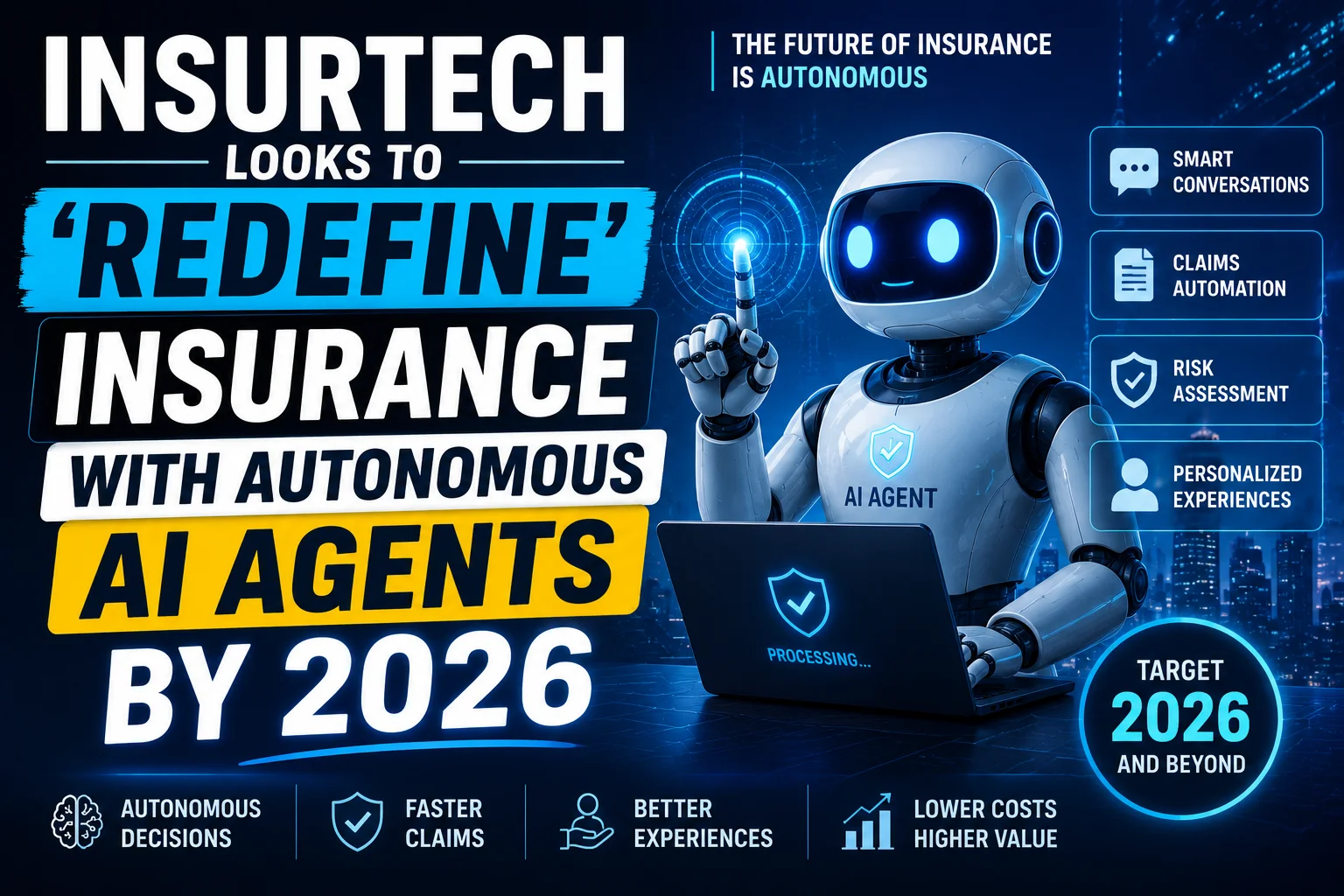
In March 2026, Cytora launched Autopilot, a first-of-its-kind agentic AI capability that enables underwriting and claims workflows to run themselves from submission to decision.
Here's what that looks like in practice:
Traditionally, an underwriter might spend up to 50% of their time on manual processes: reviewing submissions, identifying missing data, and writing follow-up emails to brokers. It's tedious, error-prone, and expensive.
With Cytora Autopilot, the workflow executes automatically. The AI agent:
-
Aggregates and interprets data from internal systems, external sources, emails, documents, and even recorded calls.
-
Links communications that arrive days apart, assembling a complete 360° view of the risk.
-
Identifies missing information, auto-responds to the broker, and waits for new data to arrive.
-
Reviews the complete submission, determines eligibility for automated decisioning, and executes straight-through processing.
The result? Insurers move from spending hours on each submission to simply supervising a self-executing flow of risk. Brokers receive quotes in minutes rather than days. And human underwriters are freed to focus on complex, high-value cases that truly require their judgment.
Richard Hartley, CEO of Cytora, put it succinctly: "Autopilot marks a breakthrough in the evolution of risk digitization. The industry has reached the limits of static digitization... Autopilot changes this dynamic by enabling workflows that understand context, dynamically respond to new information, and execute autonomously as the full picture of a risk evolves."
Case Study 2: Majesco Spring '26 – Digital Teammates in Action
Not to be outdone, Majesco unveiled its Spring '26 Release in April 2026, with a theme aptly titled "Redefine Possible."
The headline feature? Thirteen new AI agents introduced across their property & casualty (P&C) and life, accident & health (L&AH) portfolios.
These agents aren't just fancy chatbots. They are governed digital teammates designed to handle high-volume, multi-step work across quoting, servicing, billing, and claims.
As Majesco explains, "Instead of static rules or isolated automations, governed digital agents interpret context, follow carrier-specific guardrails, and carry out multi-step workflows from start to finish... The people become the orchestrator, the manager, the supervisor of a fleet of digital teammates."
For life and health insurers, the release includes agents that support complex work like bill validation, payment reconciliation, and claim reopening. For P&C carriers, the agents integrate real-time weather intelligence to help adjusters stay ahead of catastrophe exposure.
Eighty-two percent of insurance leaders believe AI will define the future of this industry. Yet only fourteen percent have fully integrated AI into their operations. Majesco is betting that 2026 is the year that gap closes.
Beyond the Hype: Real Challenges Facing Agentic AI
Of course, no emerging technology is without its growing pains. For all the excitement around Agentic AI, industry experts are quick to point out significant hurdles.
The "80/20 Reality"
According to Magdalena Ramada Sarasola, Global Insurtech Innovation Lead at WTW, today's AI agents perform exceptionally well on repetitive, data-intensive tasks but still struggle with the final 20% of cases that require contextual judgment.
In other words, an AI agent can easily extract data from a standard claim form. But can it understand why a claim involving ambiguous medical history or unusual circumstances should be approved? Not yet—and maybe not for another decade.
"There are a lot of technical hurdles to doing that effectively," Sarasola warned, "and it might not happen in the next 10 years."
The Accountability Problem
When an AI agent makes a mistake, who is liable? Is it the insurer? The software vendor? The data provider?
This question becomes even murkier when multiple agents interact. Scott Ross, an Emerging Technology Specialist at AWS, raised a critical point: "Customers are looking for those agents to be, quote, 'certified.' If I have an agent that does a regulatory check and the partner guarantees that it will be accurate, and if I buy this agent, then who's liable?"
The industry doesn't have a clear answer yet. But regulators are paying attention. The EU AI Act, data protection laws, and financial services authorities are all developing frameworks that will determine how autonomous decisions can be made—and who answers when things go wrong.
Data Governance: Garbage In, Garbage Out
Agentic AI is only as good as the data it can access. And let's be honest—most insurers are sitting on decades of legacy data that is poorly labeled, fragmented across siloed systems, and riddled with inconsistencies.
"In the past, insufficient labelling of data and especially documents did not have a severe impact," noted Tim Hilbig, Head of Digital Concepts at Euler Hermes. "We really have to rethink how we approach data and document management now."
Before deploying AI agents, insurers need to get their data houses in order. That means clean data models, central data platforms, and clear rules for access rights and retention. It's not glamorous work, but it's essential.
The Human Factor: AI as Teammate, Not Replacement
Perhaps the most important question surrounding Agentic AI is what it means for the people working in insurance.
The fear is understandable: if AI agents can handle underwriting and claims, what happens to underwriters and claims adjusters?
Industry leaders are unanimous on this point: AI is here to augment, not replace.
At a recent ITC London panel, Scott Sayce, Chief Innovation Officer at DUAL Group, stressed that "culture and talent are what determine whether that technology actually gets used, and used in the right way."
The vision for 2026 and beyond is a hybrid workforce where humans and AI agents collaborate.
-
AI agents handle repetitive, time-consuming tasks: data extraction, document verification, initial claims triage, and straightforward approvals.
-
Humans focus on high-value judgment calls: complex claims, unusual risk assessments, customer empathy, and strategic decisions.
As one expert put it, "We can have phenomenal technology in this industry, but culture and talent are what determine whether that technology actually gets used, and used in the right way."
This means insurance professionals will need new skills. Traditional clerks will increasingly become "agent managers"—supervising AI workflows, handling exceptions, and continuously fine-tuning the agents. That requires training, change management, and a mindset shift.
A Global Perspective: Agentic AI Reaches India
While much of the discussion around Agentic AI focuses on North America and Europe, the technology is rapidly going global.
In a significant development, SBI Life Insurance, one of India's most trusted life insurers, recently partnered with Datamatics to deploy an Agentic AI-powered underwriting solution called TruAI Underwriting.
The platform ingests and analyzes medical reports, laboratory results, and declarations—extracting key parameters and highlighting potential risk indicators. It generates a consolidated digital case summary and provides intelligent decision support based on underwriting rules and historical outcomes.
Importantly, the system includes self-learning capabilities, continuously improving its risk evaluation over time. However, the final decision authority remains with human underwriters to ensure governance and regulatory compliance.
This hybrid model—AI-assisted but human-approved—is likely to become the global standard for sensitive decisions like life insurance underwriting.
The Road Ahead: What to Expect by 2030
According to Munich Re and ERGO's "Tech Trend Radar 2026," Agentic AI is one of the 25 technologies with the greatest potential to reshape risk assessment and strategic decisions for insurers.
What can we expect by the end of the decade?
The technology is evolving fast, but so are the challenges. As Kornelia Schaffranka of adesso wrote, "In five years, traditional clerks will increasingly become agent managers... This is not a job reduction, but a skill shift. It must already be reflected today in a modern, technology-oriented HR approach."
Conclusion: The Choice Is Irreversible
Here's the reality: Inaction is no longer a neutral position.
The data is clear. The market is moving. Competitors are investing. And customers—whether they are individuals filing a claim or brokers submitting a risk—are beginning to expect speed and efficiency that only autonomous systems can deliver.
As Majesco warned in its Spring '26 announcement, "Inaction is not a neutral position. It is a strategic choice with real business consequences. 2026 is the year that choice becomes irreversible."
For Syntaxcrow readers, the message is simple: whether you are an insurer, an InsurTech founder, or an investor, now is the time to understand Agentic AI. Not next year. Not when the technology is "perfect." Now.
The agents are coming to an insurance workflow near you. The only question is whether you will lead, follow, or get out of the way.