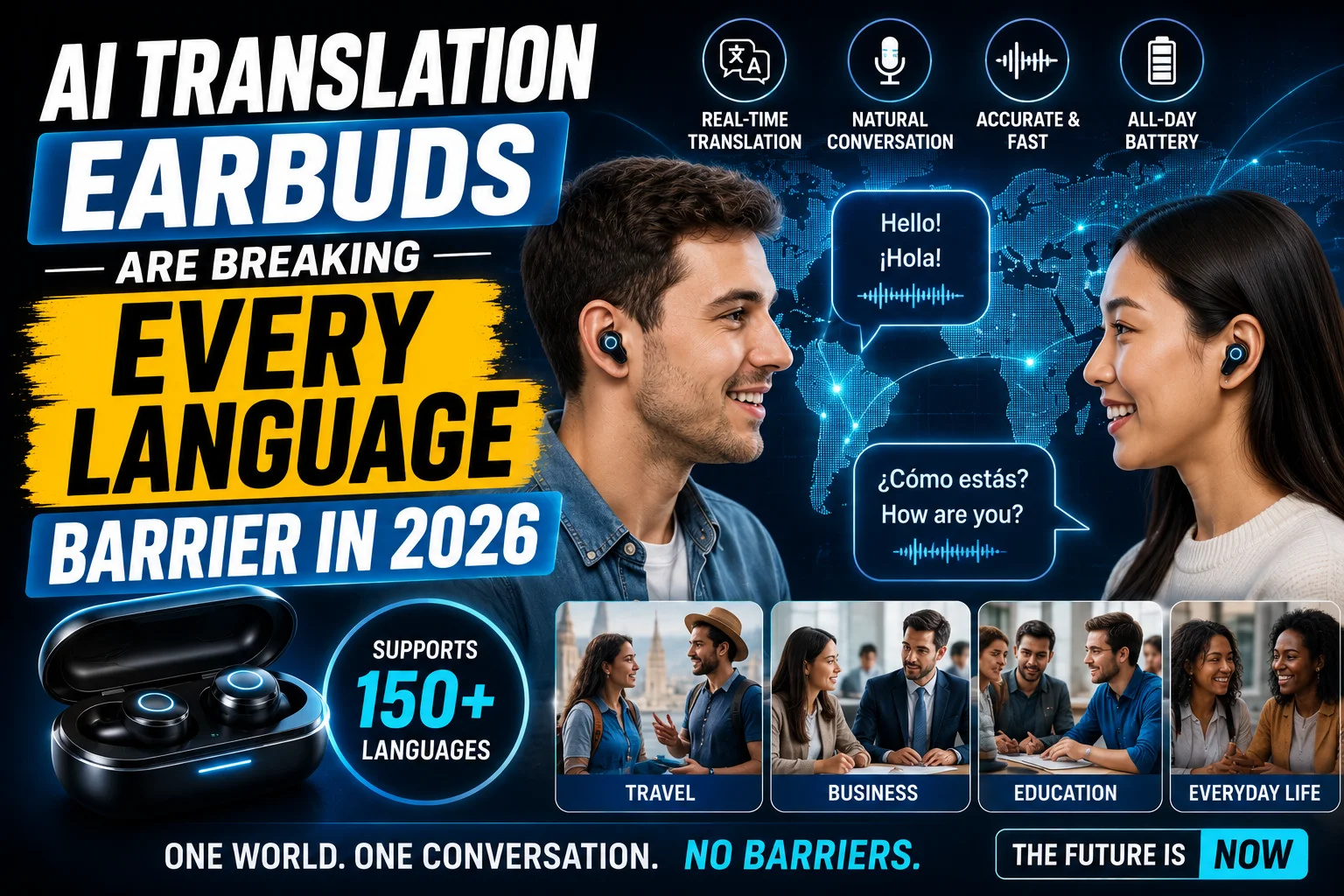
Key Takeaways:
-
The global translation earbud market is exploding, projected to grow from 341millionin2025to341millionin2025to4.76 billion by 2032 – a staggering 46.0% compound annual growth rate .
-
Dedicated translation earbuds like Timekettle W4 Pro now achieve up to 98% accuracy with just 0.2 seconds of delay, even in noisy 100dB environments .
-
Tech giants (Apple, Google, Samsung) are adding translation features, but dedicated devices lead in natural conversation flow – think hands-free, one-bud-per-person interaction .
-
AI translation earbuds excel at short, face-to-face, low-stakes conversations like travel and casual business – but still need humans for legal/contract-level precision .
Introduction: The Sci-Fi Dream Becomes Your Daily Companion
Remember those sci-fi movies where characters pop a tiny device in their ear and suddenly understand every language on Earth? That future isn't 2050. It's 2026. And it's already in your pocket.
AI translation earbuds have quietly evolved from a clunky gimmick into one of the most exciting technologies of the decade. Whether you're ordering coffee in Tokyo, closing a deal in Berlin, or helping your multilingual family share a dinner table conversation, these little devices are rewriting the rules of human connection.
At Syntaxcrow, we've been tracking this space closely. And the numbers are impossible to ignore. According to QYResearch, the global simultaneous translation earbud market hit 341millionin2025∗∗andisprojectedtoskyrocketto∗∗341millionin2025∗∗andisprojectedtoskyrocketto∗∗4.76 billion by 2032 . That's not a trend. That's a revolution.
But here's the real question: Do they actually work? And which ones should you buy?
Let's dive in.
How Do AI Translation Earbuds Actually Work?
Before we get to the products, let's understand the tech behind the magic. It's more sophisticated than you might think.
Modern AI translation earbuds use a multi-stage processing pipeline :
-
Voice Capture: High-performance microphones (and sometimes bone conduction sensors) isolate your voice from background noise. The Timekettle W4, for example, uses a bone-voiceprint sensor that captures vibrations through your skull – yes, really – before sound even leaves your mouth .
-
Speech Recognition (ASR): The earbuds convert your speech to text using automatic speech recognition models trained on millions of hours of conversation.
-
AI Translation: A large language model (LLM) translates the text into your target language. Modern systems use Transformer architecture – the same tech powering ChatGPT – to understand context, idioms, and even correct homophone errors .
-
Voice Synthesis (TTS): The translated text is converted back into natural-sounding speech. The best systems (like Timekettle's upcoming feature) even clone your tone of voice to preserve emotion and nuance across languages .
The entire process happens in 0.2 to 3 seconds depending on the device and network conditions .
Market Explosion: A $4.76 Billion Opportunity by 2032
The numbers behind this industry are staggering. Let me break down what the research is showing :
What's driving this explosive growth? Three factors:
-
Post-pandemic globalization – Remote work and international travel are back, but the way we communicate has permanently changed.
-
AI maturity – LLMs have made real-time translation accurate enough for everyday use.
-
Consumer awareness – People now know this technology exists and want it.
The market includes major players like Google, Apple, Samsung, Timekettle, iFLYTEK, Anker (Soundcore), and Huawei . But as we'll see, they take very different approaches.
The 2026 Lineup: Best Translation Earbuds Compared
I've analyzed expert reviews from SoundGuys, Techlicious, and specialized testing to bring you the definitive 2026 comparison .
🏆 Best Overall: Timekettle W4 Pro
Price: $449
The Timekettle W4 Pro isn't just another pair of earbuds. It's a dedicated translation device that happens to look like earbuds. And it's the clear market leader for a reason.
What makes it special:
The One-on-One Mode is the killer feature. Each person wears one earbud and speaks naturally – no tapping screens, no waiting for turns, no holding a phone between you. Conversations flow the way they should, with interruptions, overlaps, and natural pacing all handled remarkably well .
Under the hood, the W4 Pro uses Babel OS 2.0, an AI translation platform powered by advanced LLMs. It supports 40 languages and 93 accents, claims 98% accuracy, and delivers translations in just 0.2 seconds .
The bone-voiceprint sensor is a game-changer for noisy environments. It captures sound through physical vibrations in your ear, maintaining over 90% accuracy even in 100dB chaos – think subway stations, trade show floors, or busy restaurants .
Real-world performance: SoundGuys tested the W4 Pro extensively and praised its ability to "fundamentally change how multilingual conversations feel in practice." The translated voices sound natural, and the earbuds handle phone calls and video content seamlessly .
Verdict: If you want the best experience money can buy, this is it. The $449 price is steep, but as one reviewer put it, "it's easy to justify if it replaces the need for a human interpreter even occasionally" .
🍏 Best for iPhone Users: Apple AirPods Pro 3
Price: $249
Apple entered the translation earbud game with the AirPods Pro 3, adding Live Translation as a beta feature. The results? Promising but not perfect.
What works: Integration is seamless. Setup is instant, controls are exactly where you expect them, and switching between listening modes happens automatically. For iPhone users, translation feels like a built-in capability rather than a separate app .
The AirPods Pro 3 also function as clinical-grade hearing aids, have industry-leading noise cancellation, and track your heart rate. Translation is just one feature in an incredibly versatile package .
What doesn't: Live Translation is slower than dedicated devices, struggles with background chatter, and has limited language support. It's also still in beta, which means occasional hiccups .
Verdict: At $249, you're not buying translation earbuds. You're buying excellent everyday earbuds that also translate. For most iPhone owners, that trade-off makes perfect sense.
🤖 Best for Android Users: Google Pixel Buds Pro 2
Price: $229
Google takes a different approach. The Pixel Buds Pro 2 don't have built-in translation. Instead, they integrate seamlessly with Google Translate – which is already incredibly powerful and supports over 100 languages for free.
What works: If you're on a Pixel phone, live translation feels like a native feature. Everything lives inside Android – no juggling apps or fighting the OS. The redesigned fit keeps the earbuds secure, and microphone quality is excellent even in noisy environments .
What doesn't: You still need to use your phone as an intermediary. Unlike the Timekettle's hands-free experience, the Pixel Buds work best when one person holds the phone and speaks into it. It's not as natural, but it's far more affordable .
Verdict: The best value pick for Android users who already rely on Google Translate.
📱 Best for Samsung Users: Galaxy Buds3 Pro
Price: ~$250 (varies)
Samsung's entry leverages Galaxy AI and the native Interpreter mode on newer Galaxy phones.
What works: You hear real-time translations directly in your earbuds while your phone displays transcriptions for both speakers. It's tightly integrated and works well in quiet environments .
The Buds3 Pro also function as solid everyday earbuds with decent sound quality, strong bass, and an IP57 rating for sweat and rain resistance.
What doesn't: The feature prefers quiet environments and isn't as responsive as dedicated devices. Like Google, it requires phone interaction .
Verdict: The obvious choice for Samsung loyalists. For everyone else, the Pixel Buds or Timekettle make more sense.
💰 Best Budget Pick: EarFun Air Pro 4+
Price: $99
Yes, you can get AI translation for under $100. The EarFun Air Pro 4+ received a firmware update that added two translation modes: Face-to-Face for quick exchanges and Real-Time for longer statements .
What works: At this price, the mere fact that it translates at all is impressive. The feature is genuinely useful for travelers on a tight budget.
What doesn't: Don't expect dedicated-device performance. Accuracy is lower, latency is higher, and you'll need to manage expectations.
Verdict: Perfect for budget-conscious travelers who need translation occasionally, not daily.
Head-to-Head Comparison Table
Sources:
Real-World Case Study: The Multilingual Family Table
One of the most heartwarming applications of this technology comes from a use case the manufacturers didn't initially anticipate.
According to Timekettle's team, early users included multilingual families – think international marriages, adoptive families helping children retain native languages, or grandparents who don't speak their grandchildren's primary language .
At a typical family dinner, the noise levels can reach 70-80dB. Kids interrupt. The TV plays in the background. Someone's chopping vegetables in the kitchen. In this chaos, traditional translation apps fail.
But the Timekettle W4 handles it. The bone-voiceprint sensor filters out everything except the wearer's voice. The semi-in-ear design (just 5.7 grams per bud) stays comfortable for hours. And the one-bud-per-person setup means conversations flow naturally – grandpa speaks Mandarin, the translation whispers in English to the grandkids, and everyone laughs at the same jokes .
As one reviewer put it, "The core of family communication is emotional connection. A joke, a word of comfort, or a familiar nickname carries meaning beyond literal definitions. The best devices preserve that emotion" .
Case Study: From Crisis to Comeback – The Timekettle Story
The company leading this revolution almost didn't survive.
Timekettle was founded in 2016 by Leal Tian (田力), who was inspired by two things: reading sci-fi author Isaac Asimov's The End of Eternity as a teenager, and watching his mother struggle to get help during a medical emergency in Europe because she couldn't speak the local language .
The vision was simple: "Make AI work for real human conversation, not just button-pressing."
But the path was brutal. In 2019, Timekettle launched a product called "Zero" – a portable translator. It crushed its crowdfunding goals. The company built nearly 100,000 units.
Then disaster struck.
A "crosstalk" issue caused the device to malfunction. Massive returns flooded in. The company's cash flow hung by a thread .
The lesson was painful but clarifying: They hadn't solved the two core technical challenges of translation earbuds.
Challenge #1: Bidirectional simultaneous translation. Traditional Bluetooth was designed for one microphone active at a time (phone calls). But real conversation requires both people to speak – and possibly interrupt – naturally. Timekettle had to reinvent how Bluetooth handles audio.
Challenge #2: Pure voice pickup. Normal noise cancellation is about blocking sound OUT. Translation earbuds need the opposite: capturing ONLY the wearer's voice while ignoring everything else – including the person standing right in front of them.
The breakthrough came with what Timekettle calls "Vector Noise Reduction" – an algorithm that "focuses like a spotlight" on the wearer's mouth, filtering out the对面 person's voice and environmental chaos .
Today, Timekettle has three product lines:
-
W Series: For face-to-face conversations (W4 Pro flagship)
-
X Series: For multi-person meetings (simultaneous translation for up to 5 languages)
-
T Series: Offline translation for travelers
The company now serves over 170 countries and recently proved its mettle in a human vs. AI translation competition – beating professional human translators on accuracy (though the humans still won on natural flow and cultural nuance) .
The Tech Behind the Magic: Babel OS 2.0
At the heart of Timekettle's W4 Pro is Babel OS 2.0 – an AI translation platform that represents a genuine leap forward .
What makes Babel OS different:
-
Contextual understanding: It doesn't translate word-for-word. It understands the sentence's meaning and intent, automatically correcting homophones and adapting to idioms.
-
Self-learning: The system improves over time, learning from your specific interactions and vocabulary.
-
Lifetime updates: Unlike many hardware products, the translation engine gets better with age.
During testing at IFA 2025 in Berlin, I (speaking through a Techlicious reporter) had a real-time conversation with a Timekettle representative – English to Chinese and back. Even on a noisy trade show floor, the experience felt natural. The clever magnetic case design – which snaps apart so you can easily hand one earbud to whoever you're speaking with – makes the whole thing feel intuitive .
What AI Translation Earbuds Can and Cannot Do (Be Honest)
Let's cut through the marketing hype. According to comprehensive testing by Soundcore and others, here's the real picture :
✅ What They CAN Do Well:
❌ What They CANNOT Do (Yet):
The bottom line: Think of AI translation earbuds as a brilliant assistant for everyday conversations – not a replacement for a certified interpreter in high-stakes situations.
One study from Certified Languages explains the core limitation: "This delay is likely caused by the device's need to initialize its speech recognition system, which takes a moment to process before capturing the audio input. Essentially, the device 'listens' for a second to understand the speech patterns before it begins interpreting, similar to how buffering works in video streaming" .
Beyond Earbuds: The Rise of Software-Only Solutions
Not ready to drop $450 on dedicated hardware? There's another path.
Recent software innovations have enabled AI translation through any Bluetooth earbuds paired with a smartphone app. One solution supports 17 languages, works with any audio device, and uses a freemium model (40 free minutes daily, $7.99/month for unlimited) .
Technical architecture of software-based translation :
-
Voice separation module: Blind source separation extracts clean speech from background noise
-
Feature encoding: 128-dimensional MFCC (Mel-frequency cepstral coefficients) represent voice characteristics
-
Translation engine: Transformer-based Seq2Seq model for semantic conversion
-
Voice restoration: WaveNet variant generates speech similar to the original speaker's voice
Latency is higher (800ms+ in 4G networks), but the barrier to entry is zero. If you already own AirPods or Galaxy Buds, try the software route before buying dedicated hardware .
The Privacy Question: Is Your Conversation Being Recorded?
This is a legitimate concern. Translation earbuds, by definition, need to send your voice to cloud servers for processing. So what happens to that data?
Good news: Major manufacturers are taking privacy seriously.
-
Timekettle complies with GDPR and FERPA standards. The company explicitly states that "no conversations are used for AI training or shared with third parties" .
-
Apple processes as much as possible on-device (for Live Translation) and uses differential privacy for anything that touches the cloud.
-
Google and Samsung have more mixed records – their free services are ad-supported, which inevitably means some data usage for improving their models.
Recommendation: If privacy is your primary concern, choose a paid, dedicated device from a company that makes its data policies clear. The free software options are convenient but come with trade-offs.
The Future: What's Coming by 2030
The technology is evolving fast. Here's what industry experts predict :
Near-term (2026-2027):
-
Voice cloning for translation – The device will translate AND speak in your actual voice (same tone, cadence, emotion). Timekettle has already teased this feature.
-
Mid-sentence translation – No more waiting for pauses. The AI will translate continuously, even handling interruptions.
-
Confidence ratings – The system will tell you when it's unsure ("75% confidence") so you can double-check.
Medium-term (2028-2030):
-
Offline-first models – Edge computing will enable high-quality translation without internet.
-
AR integration – See subtitles floating over people's heads through smart glasses.
-
100+ languages with dialect support – Including regional variations (e.g., recognizing different Chinese dialects like Cantonese vs. Mandarin).
Long-term vision (2030+): Timekettle's CEO calls this "L4 or L5 stage translation" – a future where conversation flows across languages as naturally as if everyone were speaking the same tongue .
At an IFA panel, Prof. Dr. Thomas Kosch, a Human-Computer Interaction Specialist at Humboldt University, offered a balanced prediction: "Human interpreters are still irreplaceable in sensitive cultural or diplomatic contexts… In the future, both will complement each other – AI for everyday communication, humans for depth and nuance" .
Syntaxcrow's Buying Guide: Which Should You Choose?
Scenario 1: You frequently travel for business or pleasure and want the BEST experience.
👉 Buy the Timekettle W4 Pro ($449) – It's expensive, but it's genuinely transformative.
Scenario 2: You're already deep in the Apple ecosystem and want translation as a bonus feature.
👉 Buy the Apple AirPods Pro 3 ($249) – Excellent everyday earbuds that also translate.
Scenario 3: You're an Android user who wants solid translation without breaking the bank.
👉 Buy the Google Pixel Buds Pro 2 ($229) – Best value integration with Google Translate.
Scenario 4: You're a casual traveler who needs translation occasionally and wants to spend under 100.∗∗👉∗∗BuytheEarFunAirPro4+(100.∗∗👉∗∗BuytheEarFunAirPro4+(99) – It works, and the price is unbeatable.
Scenario 5: You already own decent earbuds and want to test translation before buying hardware.
👉 Try a software solution first – Download a translation app and see if it meets your needs. Upgrade to hardware only if you need hands-free, low-latency conversation.
The Verdict: A Revolution, Not a Gimmick
Three years ago, AI translation earbuds were a novelty – fun to show off at parties but not reliable enough for real use.
In 2026, they've matured into a genuinely useful tool that can transform how you travel, work, and connect with people.
The market knows it. 341millionin2025,projectedtohitnearly341millionin2025,projectedtohitnearly5 billion by 2032 . Tech giants are piling in. Dedicated specialists like Timekettle are pushing the boundaries of what's possible.
No, they won't replace human interpreters for diplomatic negotiations or court proceedings. Yes, they still struggle with noisy restaurants and overlapping conversations.
But for the vast majority of everyday situations – ordering dinner in Rome, asking for directions in Tokyo, helping your bilingual family share a laugh – they work. And they work well.
The future of communication isn't everyone learning English. It's everyone wearing a tiny device that makes language irrelevant.
And that future is already here.