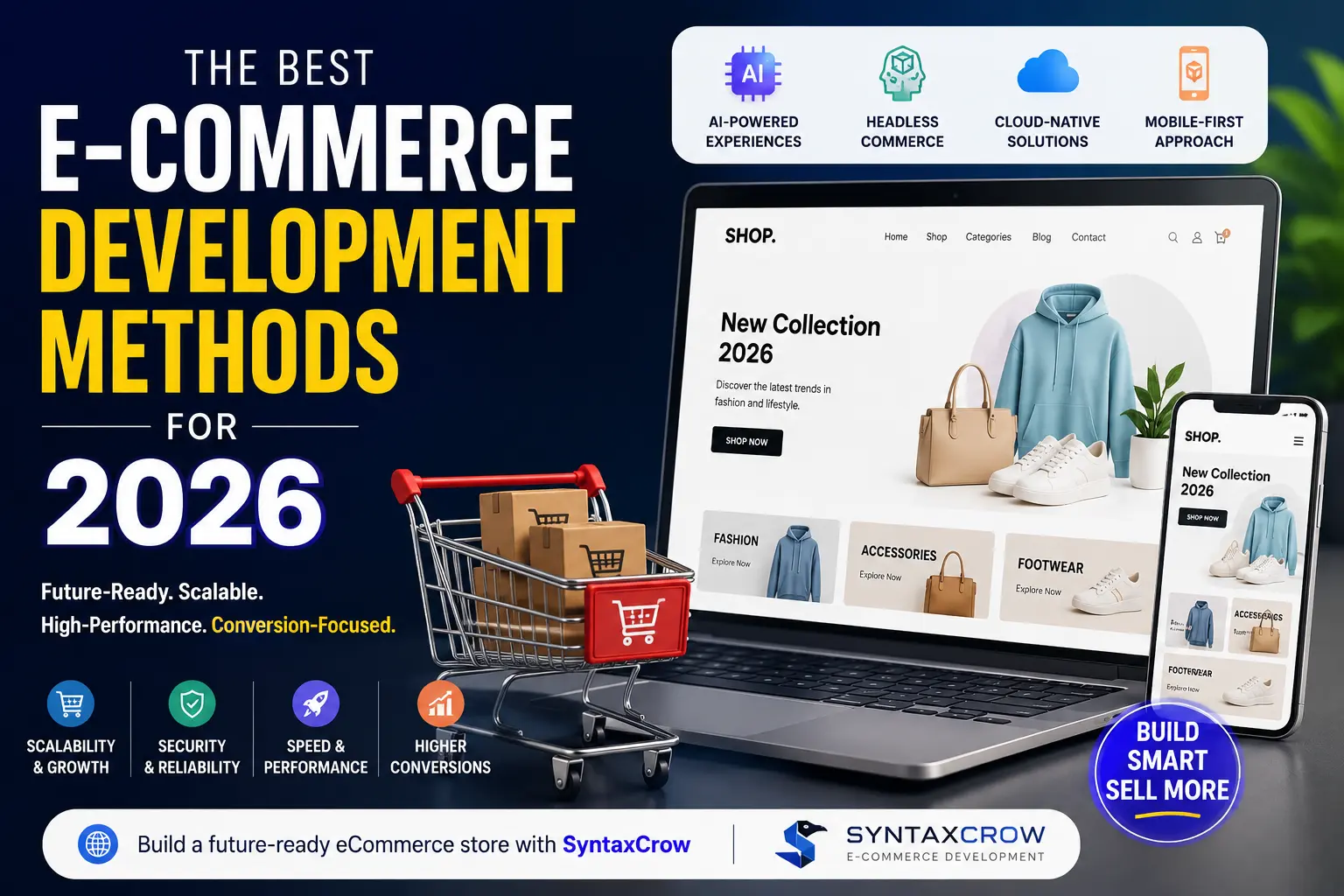
The ecommerce landscape has fundamentally shifted. The "growth at all costs" era is over. In its place, profitability, efficiency, and AI-driven personalization have taken center stage . For businesses looking to build or rebuild an online store in 2026, the technical choices you make today will determine whether you thrive or merely survive.
Generic templates and monolithic platforms no longer cut it. Shoppers expect hyper-personalized experiences, blazing-fast load times, and the ability to buy anywhere—from a social media post to an AI chatbot. This guide explores the best ecommerce development methods for 2026, drawing on the latest trends in composable architecture, agentic AI, and conversion-focused design.
Key Stat: According to Gartner, businesses that execute the right digital strategies successfully increase profitability by 77% . The question isn't whether to invest in modern ecommerce development—it's how.
1. Composable Commerce: The End of the Monolith
If there's one development method that defines 2026, it's composable commerce. The days of rigid, all-in-one platforms (monoliths) are numbered. By 2027, over 60% of mid-sized and large retailers will rely on composable architectures .
What It Is & Why It Matters
Composable commerce means building your tech stack from interchangeable, best-in-breed components. Instead of being locked into a single vendor for CMS, search, cart, and checkout, you assemble them via APIs, like LEGO bricks.
-
The "MACH" Architecture: This stands for Microservices, API-first, Cloud-native, and Headless. 92% of US brands have already adopted this modular approach .
-
The Benefit: Unmatched flexibility. Want to swap your search engine for a more AI-powered option? You can, without rebuilding your entire checkout flow. Need to launch a mobile app? Your headless backend serves it instantly.
How to Implement in 2026
You don't have to rebuild everything overnight. The smartest method is the "strangler pattern" —gradually replacing legacy systems.
-
Decouple the Frontend First: Move to a Headless CMS (like Contentful or Sanity) while keeping your old backend.
-
Adopt Packaged Business Capabilities (PBCs): Replace the checkout, then the cart, then the search.
-
Vendor Options: For enterprises, commercetools is the gold standard. For mid-market, Shopify Plus now offers surprising composability with its extensive ecosystem of headless components .
Learn More: Explore headless ecommerce development options →
2. AI-First Development: Personalization at Scale
In 2026, AI is not a "nice-to-have" feature; it is the operating system of a successful ecommerce store . However, the method has evolved from simple "customers also bought" widgets to agentic commerce.
Moving Beyond Chatbots: Agentic AI
Forget the clunky FAQ bots of the past. Agentic AI refers to autonomous agents that perform multi-step tasks for the user. A customer might tell an AI agent: "Find me a waterproof jacket under $150 with high ratings and buy the one with the best reviews" .
Development Implication: You must optimize your backend for machine-to-machine (M2M) communication. Your API needs to be structured so that AI agents can read your product data, check inventory, and execute a purchase without a human clicking a mouse.
Hyper-Personalization via Edge AI
Generic experiences convert at roughly 2%. Hyper-personalized experiences convert at 6%+ .
-
The Method: Use Edge AI to analyze real-time behavior. If a user hovers over a pricey watch for 5 seconds but doesn't click, the very next page load should show watches in a similar style or a financing option.
-
The Tech: This requires a Headless setup where the frontend can react instantly without waiting for the backend to "catch up."
Visual & Voice Search Development
Text search is archaic. Development teams must integrate multi-modal search capabilities.
-
Visual Search: Allow users to upload a photo (e.g., of a couch) to find matching products. This requires vector databases that convert images into mathematical embeddings .
-
Voice Commerce: With 1/3 of shoppers starting with an AI assistant, your schema markup and natural language processing (NLP) are critical for discoverability .
Stat: The AI-enabled ecommerce market is expected to reach $64.03 billion by 2034, growing at nearly 16% annually .
Ready to integrate AI into your store? Get a free consultation →
3. "Profit-First" Performance Engineering
In 2026, profitability trumps vanity metrics. Development methods are shifting focus from pure traffic acquisition to conversion rate optimization (CRO) and cart abandonment reduction.
The Need for Speed (Core Web Vitals)
Google’s algorithm now prioritizes user experience above all else. Every 1-second delay in load time reduces conversions by 2% .
Development Priorities:
-
Mobile-First Indexing: Google exclusively uses the mobile version of your site for ranking. Responsive design is baseline; we build mobile-only architecture for speed.
-
Core Web Vitals: We obsess over Largest Contentful Paint (LCP—should be under 2.5 seconds) and Cumulative Layout Shift (CLS—no jumping buttons) .
Checkout Optimization (The "Zero-Click" Era)
Shoppers want to buy where they stand.
-
One-Page & Guest Checkout: Reduce friction. Remove unnecessary account creation steps.
-
Checkout Extensibility: Allow purchases to happen in-situ (e.g., a "Buy Now" button inside a TikTok video or an Instagram DM). Your development stack must support headless checkout APIs that can be embedded anywhere .
See how SyntaxCrow optimizes for 70% faster checkout →
4. SEO & Discoverability for the AI Era (AIO)
Search Engine Optimization (SEO) is evolving into AIO (Artificial Intelligence Optimization) . In 2026, you aren't just ranking for Google; you are ranking for ChatGPT, Perplexity, and Gemini .
How to Develop for AI Discovery
-
Structured Data is Mandatory: AI crawlers eat schema markup for breakfast. Product schema, FAQ schema, and Review schema tell the AI exactly what you sell.
-
Answer Engine Optimization: Create FAQ sections that directly answer "Who, What, Where, When, Why, and How." You want your product to be the answer the AI reads aloud to the user .
-
Consolidate Authority: Stop churning out low-quality blog posts. AI prioritizes depth over volume. Build "pillar pages" and "topic clusters" to establish topical authority .
The Trust Factor
As AI generates more content, authentic User-Generated Content (UGC) becomes your strongest asset. Verified reviews and real customer photos act as trust signals to both algorithms and humans .
Insight: By 2026, 49% of customers start and end their shopping journeys on retailer websites or apps. If your on-site search doesn't use NLP (Natural Language Processing), you are losing sales .
5. B2B & Marketplace Development
The lines between B2C and B2B are blurring. B2B buyers demand the same "Amazon-like" experience they get as consumers.
B2B Consumerization
Old B2B portals were ugly and hard to use. In 2026, B2B development focuses on:
-
Individualized Catalogs: Different pricing and product visibility for different wholesale clients.
-
Bulk Ordering & Reordering: Streamlined interfaces for quick re-ordering of high-volume SKUs.
-
Net Terms & Quotes: Digital workflows for "Order Later" or "Request Quote" functions that used to require phone calls .
Multi-Vendor Marketplaces
Building a marketplace (like Etsy or Amazon) is complex but profitable. The 2026 method involves:
-
Vendor Dashboards: Self-service portals for sellers to manage inventory and fulfillment.
-
Commission Engines: Automated logic for splitting payments between the platform owner and the vendor.
-
Dispute Resolution: Workflows to handle returns and conflicts without manual admin.
Build a Custom B2B or Marketplace Platform →
The Bottom Line: A 2026 Development Checklist
Before you start your next ecommerce project, ensure your development partner is prioritizing these five pillars:
-
Architecture: Is it Composable/Headless? Can you swap out the search or cart without rebuilding the whole site?
-
AI Integration: Does the platform support agentic commerce, visual search, and real-time personalization?
-
Performance: Does the hosting infrastructure guarantee sub-2-second load times on mobile globally?
-
AIO Readiness: Is the codebase rich with structured data and semantic HTML for AI crawlers?
-
Profit Engineering: Is the checkout flow optimized for zero-click purchases and abandoned cart recovery?
Ready to Build the Future of Ecommerce?
At SyntaxCrow, we don't just build websites; we build high-converting digital revenue engines. Whether you need a custom WooCommerce solution, a scalable Shopify Plus build, or a complex multi-vendor marketplace, our development methods are aligned with 2026's best practices.
Don't let outdated tech kill your conversions.
👉 Get Your Free Ecommerce Consultation & Quote
*We serve clients globally (USA, UK, UAE, Australia, India) with 24/7 development support.*