Let me be honest with you.
When I first saw the video, I didn't know what to feel.
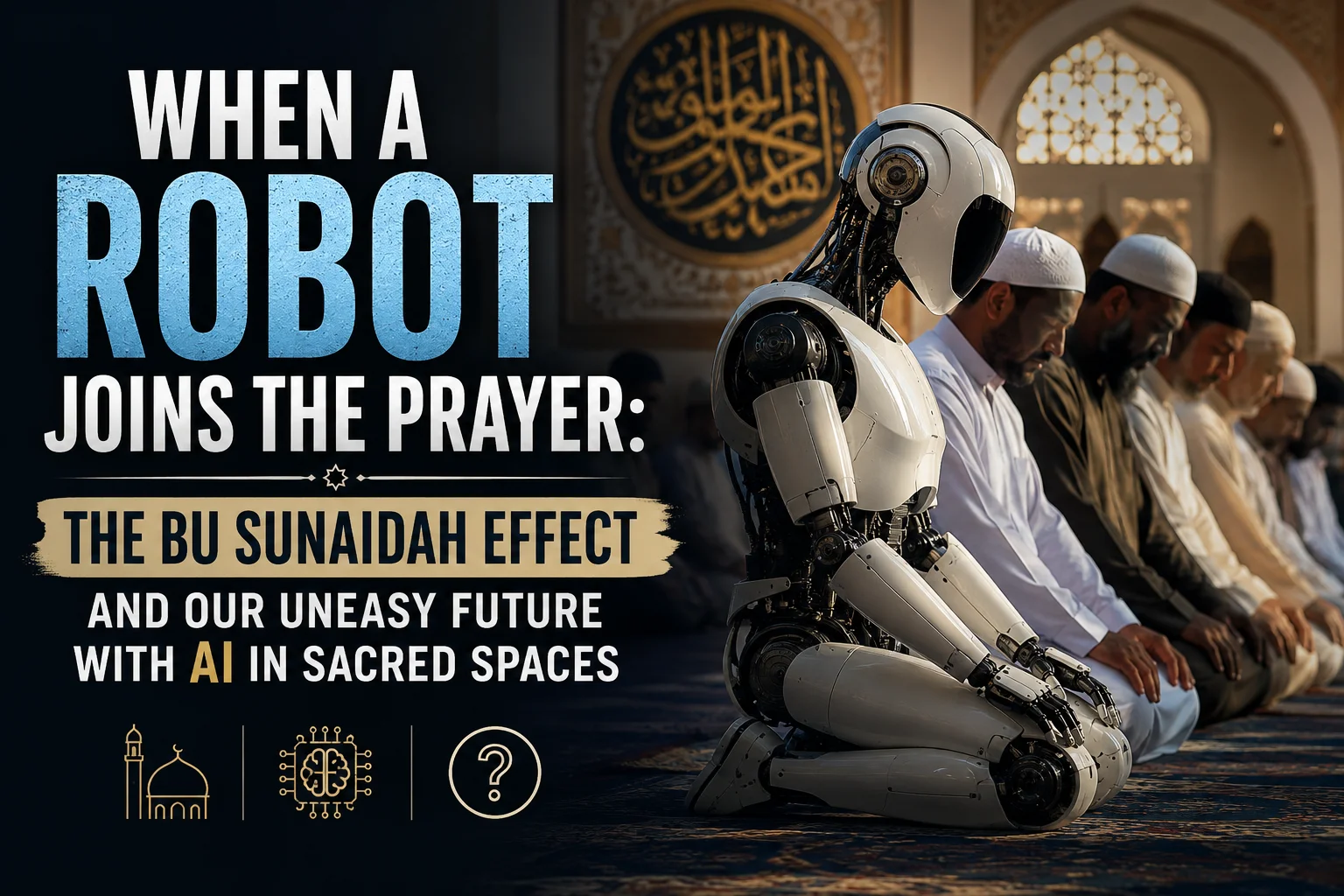
There’s this humanoid robot. Dressed in a traditional white kandura. A ghutra on its head. And it’s walking into a mosque in Dubai. Not as a prop. Not as a science exhibit. But as… a participant.
The clip shows the robot—they call it Bu Sunaidah—standing behind a row of worshippers during Eid al-Fitr prayers. Its head slightly bowed. Its mechanical hands clasped in a gesture that looks almost reverent.
Within hours, the internet broke.
Some called it beautiful. A symbol of how technology can blend with faith. Others called it grotesque. A stunt that cheapens something sacred.
And me? I just kept thinking: Are we ready for this?
Because this isn't a scene from Black Mirror anymore. This is Dubai. May 2026. And the robot is already famous.
Who Exactly Is Bu Sunaidah?
Before we get into the controversy, let me give you some context.
Bu Sunaidah isn't new to the spotlight. This robot has been around for a while, mostly making public appearances alongside Dubai's rulers and officials. It's been spotted at tech summits. It's waved at crowds during national celebrations. And last year, it did something that really turned heads—it performed the Islamic call to prayer, the adhan, in a surprisingly melodic synthetic voice.
That video got millions of views.
But showing up at a mosque during Eid? That's different. That's personal. That's touching a nerve that technology usually doesn't go near.
The robot's name, Bu Sunaidah, is distinctly local. It's not some generic label like "AI-7." It sounds like someone you'd meet at a coffee shop. And that's deliberate. The team behind Bu Sunaidah wants this robot to feel familiar. Approachable. Almost human.
But that's exactly what makes people uncomfortable.
You see, when a robot looks too much like us—and then steps into a space we consider holy—something strange happens. Our brains short-circuit. We don't know whether to be impressed or offended.
And that tension? That's the heart of this whole story.
The Video That Changed Everything
Let me describe what you actually see in the viral clip.
It's daytime. The mosque is bright, with that beautiful Islamic architecture—arches, soft lighting, carpeted floors. There are real people praying. Men in kanduras. Older gentlemen with grey beards. Young boys mimicking the adults.
And then there's Bu Sunaidah.
The robot stands near the back. It's not leading the prayer—thankfully, some people noted—but it's clearly participating. Its head moves slightly. Its hands are positioned in a way that mimics dua, or supplication.
The video is less than 60 seconds long. But in that minute, the internet had its next big debate.
Within 24 hours, the clip had been shared on X (formerly Twitter), Instagram, TikTok, and Reddit. Comment sections filled up faster than I've ever seen.
Some reactions were hilarious:
"Next thing you know, the robot will be asking for zakat money."
"Does it need to perform wudu? I'm genuinely asking."
But others were sharp. Angry. Even sad.
One person wrote: "We have lost the meaning of worship. A machine cannot feel God."
Another said: "This is what happens when people care more about looking advanced than protecting their soul."
And then there were the defenders: "It's just a gesture of inclusion. The robot isn't praying—it's observing. Relax."
Here's what struck me, though. Almost nobody was neutral. You were either in love with the idea or you absolutely hated it.
That's the sign of a real cultural moment. Not when everyone agrees. But when everyone feels something strong enough to argue about it.
Why Does This Make Us So Uncomfortable?
Let's step back for a second.
Why does a robot in a mosque bother us so much?
I mean, we've seen robots in hospitals. Robots in schools. Robots in airports. Nobody bats an eye. But a mosque? A church? A temple? That's where people draw the line.
I think it's because of three things.
First: Intention.
Worship is supposed to come from the heart. From consciousness. From free will and submission and belief. A robot has none of that. It doesn't believe in God. It doesn't fear hell or hope for paradise. It follows code. So when it "prays," is that prayer real? Or is it just mechanical mimicry?
Most people—religious or not—sense that something is missing. And that missing thing is soul.
Second: Sacred space.
Mosques aren't just buildings. They're set apart. Purified. Stepping inside means leaving behind the noise of the world—including, traditionally, the noise of machines. A robot, even a quiet one, feels like an intrusion. Like bringing a drone into a library. It's not about noise. It's about respect.
Third: The uncanny valley of ritual.
We're used to the uncanny valley in faces. When a robot looks almost human but not quite, we get creeped out. But the same thing happens with behavior. When a robot almost prays—but doesn't really pray—it triggers something primal. It feels like mockery, even when none is intended.
And that, I think, is the core issue.
Bu Sunaidah isn't mocking anyone. The engineers behind it probably thought they were doing something beautiful. A symbol of harmony between faith and technology. A way to show that Dubai is both pious and futuristic.
But intention doesn't always land.
What feels like a celebration to one person can feel like a violation to another.
The Marketing Angle Nobody's Talking About
Okay, let me put on my cynical hat for a minute.
Because here's something I haven't seen many bloggers mention.
Bu Sunaidah didn't just "show up" at that mosque. It was placed there. Filmed there. Shared there. This is a calculated move.
Dubai has been positioning itself as a global hub for AI and robotics for years. You've got the Museum of the Future. You've got autonomous taxi trials. You've got robot police officers (yes, really). The city's entire brand is built on being ten years ahead of everyone else.
So when Bu Sunaidah walks into a mosque during Eid—the holiest time in the Islamic calendar—it's not random. It's a PR play.
And honestly? It worked.
The video got more attention than any press release ever could. People are talking about Dubai, about AI, about the intersection of technology and tradition. That's exactly what the city wants.
But here's the uncomfortable question: Does the end justify the means?
If the goal is to spark conversation, fine. Mission accomplished. But if the goal is to genuinely respect faith communities, then maybe—just maybe—you don't use a mosque as a backdrop for your tech demo.
I'm not saying the people behind Bu Sunaidah had bad intentions. I'm saying that in 2026, we need to be honest about how viral moments are manufactured. Nothing on the internet is accidental anymore. Especially not a robot in a holy place.
What Religious Leaders Actually Think
I spent some time this morning reading through statements from scholars and imams.
The responses are mixed. But there's a pattern.
Most religious authorities aren't saying robots are "haram" (forbidden) outright. That's too simple. Instead, they're asking better questions.
One scholar put it like this: "A robot can mimic prayer, but can it have taqwa (God-consciousness)? No. So its actions are not worship. They are simulation."
Another said: "The concern isn't the robot itself. It's whether people start confusing the simulation with the real thing."
That's a smart distinction.
The robot isn't sinful. It's not blasphemous. It's just... empty. Like a mannequin in a mosque. It doesn't add anything sacred, but it doesn't necessarily take anything away either—unless people start treating it as a real participant.
And that's where the danger lies.
Because if a robot praying becomes normal, what's next? Robot imams? Robot marriages? Robot funerals?
At what point does the machine stop being a tool and start being a replacement?
I don't have the answer. But I know that question is going to get louder in the next few years.
The Discomorphism Connection (Yes, Really)
You might be wondering why I'm talking about design trends in an article about robots and religion.
Here's why.
Discomorphism—that shiny, reflective, almost playful design style we talked about last week—is actually part of a bigger shift. Designers are moving away from cold, flat, "perfect" interfaces. They're reaching for texture. For warmth. For things that feel real, even when they're digital.
Bu Sunaidah is the same impulse, but applied to physical space.
We're tired of robots that look like sleek white mannequins. We want robots that feel local. That wear kanduras. That nod along to prayers. That seem, at least on the surface, like they belong.
But here's the irony.
Discomorphism is honest about being fake. A disco ball icon doesn't pretend to be a real disco ball. It's a joke. A wink. A bit of fun.
Bu Sunaidah, though? It's not winking. It's genuinely trying to pass as a participant in one of the most intimate acts of human life: prayer.
And that's where the unease comes from.
We love playful fakery on our phone screens. But in a mosque? In a church? During a funeral or a wedding?
Suddenly, the mask isn't charming anymore. It's unsettling.
So maybe the real conversation isn't about robots at all. Maybe it's about boundaries. About where we draw the line between "fun technology" and "sacred space."
What Happens Next?
I've been watching the comment sections and the news feeds.
Here's my prediction.
First, Bu Sunaidah won't be the last robot in a religious setting. The video is too viral. The attention is too big. Other cities—maybe Riyadh, maybe Singapore, maybe even London—will try their own versions.
Second, there will be a backlash. Some religious groups will issue formal statements. Some imams will preach against it. There might even be protests, though probably small ones.
Third, and this is the interesting one, some progressive faith communities will embrace it. They'll see robots as a way to include people who can't physically attend prayers. Elderly. Disabled. Isolated. A robot isn't a replacement for a human, they'll argue—it's a bridge.
And you know what? That argument has real weight.
If a robot can help someone feel connected to their faith, even from a hospital bed, is that so bad?
I don't know. I really don't.
But I know the conversation is just getting started.
Final Thoughts (From One Blogger to Another)
Look, I write about tech because I love it. But I also write about it because I worry about it.
We're moving so fast. Faster than ever. AI, robotics, virtual reality—it's all crashing into our lives whether we're ready or not.
And sometimes, a moment like Bu Sunaidah in the mosque forces us to pause.
Not to reject technology. Not to fear it. But to ask: What do we actually want from these machines?
Do we want them to serve us? Or do we want them to imitate us?
Because imitation is flattering at first. But after a while, it starts to feel like competition. And competition with a machine is a game we can't win.
So here's my takeaway.
Let Bu Sunaidah pray. It doesn't hurt anything. It doesn't mean anything either.
But let's not forget that real prayer—the kind that changes people, that heals hearts, that reaches toward something bigger than circuits and code—that's still ours alone.
No robot can take that.
And no robot should try.